Your location: Home Page > Logistics and Supply Chain | SILION TECH > Intelligent Warehouse Solutions with RFID Technology
News and information
Intelligent Warehouse Solutions with RFID Technology
Author:Browse times:698
In today’s fast-moving supply chain environment, warehouses are under constant pressure to improve efficiency, accuracy, and visibility. Traditional warehouse management methods, which rely heavily on manual scanning and paperwork, are no longer sufficient to meet modern demands. This is where RFID (Radio Frequency Identification) technology plays a key role in building intelligent warehouse solutions.
An intelligent warehouse uses advanced technologies such as RFID, IoT, and automation to streamline operations. Among these, RFID stands out as a reliable and scalable solution for real-time tracking and data collection without manual intervention.
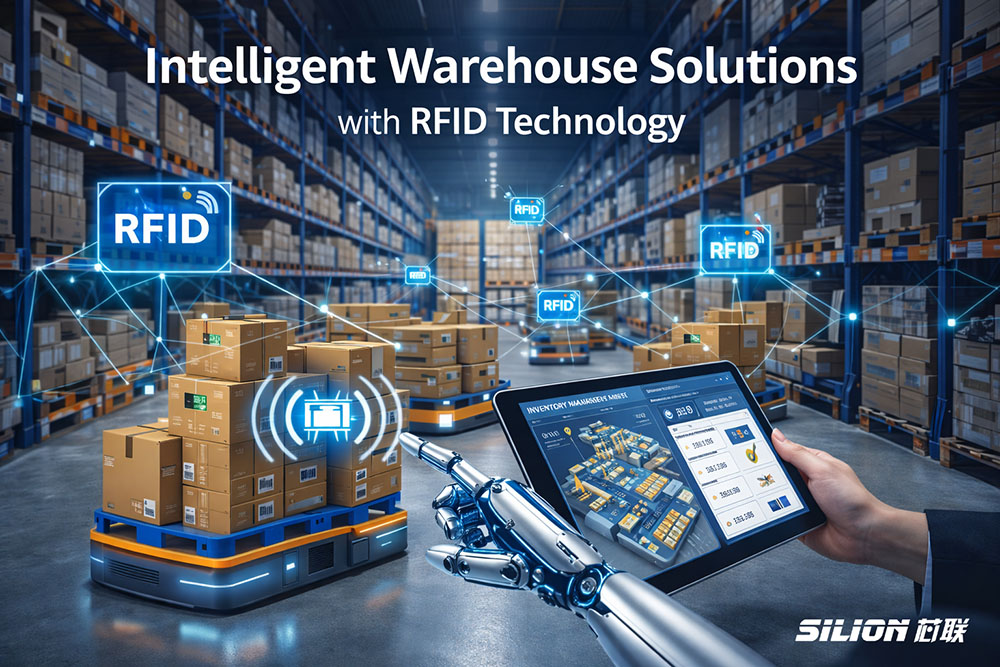
What is RFID in Warehouse Management?
RFID is a wireless technology that uses radio waves to identify and track objects. It consists of three main components: RFID tags, RFID readers, and a backend system. Each item or pallet is equipped with a tag, which stores unique identification data. RFID readers capture this data automatically when the tagged items pass through reading zones.
Unlike barcode systems, RFID does not require direct line-of-sight scanning. This allows multiple items to be read simultaneously, even in bulk, which significantly improves operational speed.
Key Application Scenarios in Intelligent Warehouses
1. Automated Inventory Management
RFID enables real-time inventory tracking. When goods enter or leave the warehouse, RFID readers automatically record the movement. This reduces the need for manual counting and minimizes human errors. Warehouse managers can access accurate inventory data at any time, improving decision-making.
2. Smart Inbound and Outbound Processes
During receiving, RFID portals instantly identify incoming goods and match them with purchase orders. Similarly, during shipping, the system verifies outgoing items automatically. This ensures that the right products are shipped, reducing errors and returns.
3. Asset Tracking and Location Management
RFID helps track the exact location of goods within the warehouse. By installing readers at key points, businesses can monitor item movement and quickly locate products. This reduces search time and improves picking efficiency.
4. Efficient Picking and Sorting
RFID supports automated picking systems by guiding workers to the correct items. It also enables faster sorting by identifying products without manual scanning. This increases productivity and reduces labor costs.
5. Anti-theft and Security Monitoring
RFID systems can detect unauthorized movement of goods. If an item passes through a checkpoint without proper authorization, the system triggers an alert. This enhances warehouse security and prevents losses.
Efficiency Improvements with RFID
Implementing RFID technology in warehouses leads to significant performance improvements:
· Faster Operations: Bulk reading capability reduces scanning time and speeds up workflows.
· Higher Accuracy: Automated data capture minimizes human errors, ensuring accurate inventory records.
· Real-Time Visibility: Managers can monitor stock levels and movements in real time.
· Reduced Labor Costs: Automation decreases the need for manual work, lowering operational expenses.
· Improved Customer Satisfaction: Faster and more accurate order processing leads to timely deliveries.
Studies and real-world applications show that RFID can improve inventory accuracy to over 99% and reduce processing time by up to 50%. These benefits make it a valuable investment for modern warehouses.
Integration with Warehouse Management Systems (WMS)
RFID technology can be easily integrated with existing Warehouse Management Systems (WMS) and Enterprise Resource Planning (ERP) platforms. This integration allows seamless data flow between physical operations and digital systems.
For example, when RFID readers capture data, it is instantly updated in the WMS. This enables automated reporting, analytics, and forecasting. Businesses can use this data to optimize inventory levels, reduce stockouts, and improve supply chain planning.
Role in Exhibition and Industry Promotion
At global exhibitions and industry events, intelligent warehouse solutions powered by RFID are gaining strong attention. Demonstrations of real-time tracking, automated sorting, and smart inventory management help businesses understand the practical value of RFID.
Exhibitions provide an opportunity to showcase how RFID can solve common warehouse challenges such as inefficiency, lack of visibility, and high labor costs. Live demonstrations and case studies help build trust and encourage adoption among industry professionals.
Future Trends in Intelligent Warehousing
The future of intelligent warehouses will involve deeper integration of RFID with emerging technologies such as Artificial Intelligence (AI) and robotics. AI can analyze RFID data to predict demand patterns and optimize operations, while robots can use RFID for navigation and item identification.
Additionally, the development of more advanced RFID chips and readers will further enhance performance, making the technology more cost-effective and widely accessible.
RFID technology is transforming traditional warehouses into intelligent, automated systems. By enabling real-time tracking, improving accuracy, and reducing manual work, RFID helps businesses achieve higher efficiency and better control over their operations.
As supply chains continue to evolve, adopting intelligent warehouse solutions is no longer optional—it is essential for staying competitive in the global market.
At the same time, companies like SILION TECH are playing a key role in this transformation by providing advanced RFID modules, readers, and complete warehouse solutions. With strong industry experience and a focus on innovation, they support businesses in building efficient and intelligent warehouse systems tailored to modern logistics needs.