Your location: Home Page > Healthcare | SILION TECH > RFID in Healthcare Management: Challenges, Technical Issues, and Solutions
News and information
RFID in Healthcare Management: Challenges, Technical Issues, and Solutions
Author:Browse times:880
Radio Frequency Identification (RFID) technology is rapidly transforming healthcare management. Hospitals and medical facilities are increasingly adopting RFID systems to track patients, manage medical assets, monitor pharmaceuticals, and improve operational efficiency. By enabling real-time tracking and automated data collection, RFID helps healthcare organizations reduce human errors, improve patient safety, and optimize workflow.
UHF RFID is primarily used for long-distance tracking of medical assets, pharmaceuticals, and equipment, while HF RFID is commonly applied to patient wristbands for short-range identification.
However, despite its benefits, implementing RFID in healthcare is not always simple. Healthcare environments are complex, highly regulated, and filled with sensitive equipment and data systems. As a result, organizations often face several technical, operational, and financial challenges when deploying RFID solutions.
This article explores the major challenges of RFID in healthcare management and explains the technical factors that hospitals must consider when implementing RFID technology successfully.
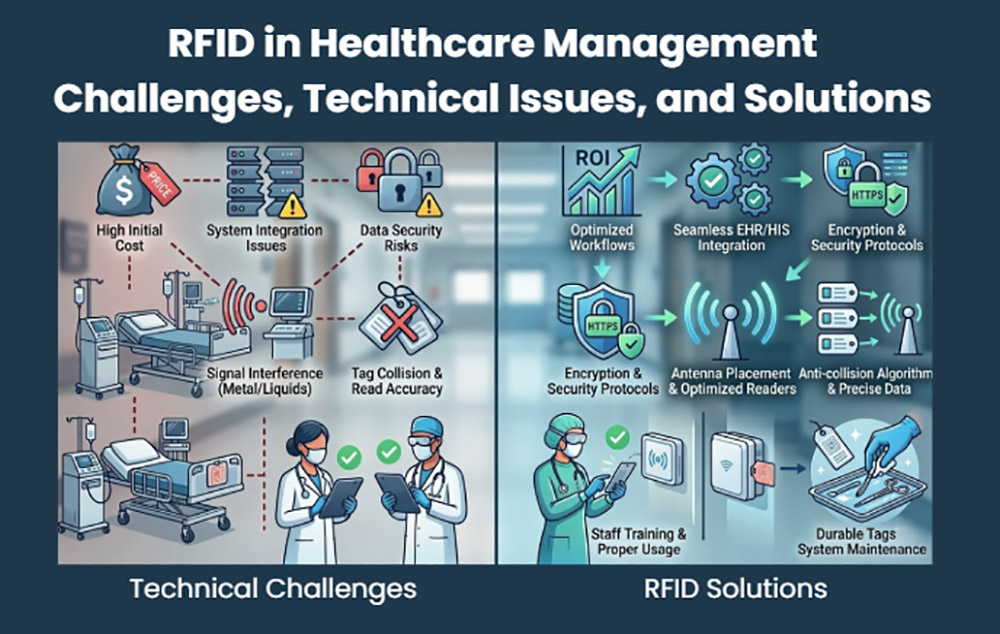
High Initial Implementation Cost
One of the most common challenges healthcare organizations face when adopting RFID technology is the high initial investment. Implementing an RFID system requires multiple components, including UHF RFID readers, antennas, tags, middleware, and software platforms.
Hospitals must also install networking infrastructure and integrate RFID systems with existing healthcare databases. In many cases, specialized medical-grade UHF RFID tags—which are resistant to sterilization and chemical corrosion—are required for medical equipment, surgical tools, or patient wristbands, which further increases costs (typically 30%-50% higher than industrial-grade tags).
Additionally, large hospitals may require hundreds of readers and thousands of tags to track assets and patients effectively. The installation, configuration, and testing of these systems can significantly increase deployment expenses.
Although RFID can reduce operational costs in the long term by improving efficiency and reducing losses, the upfront investment can be a barrier for smaller healthcare facilities.
Integration with Hospital Information Systems
Modern hospitals rely on several digital systems to manage operations. These include Electronic Health Record (EHR) systems, Hospital Information Systems (HIS), Laboratory Information Systems (LIS), and Pharmacy Management Systems.
For RFID to function effectively, it must integrate seamlessly with these existing platforms. However, integration can be technically complex because many hospitals use legacy software systems that were not originally designed to support RFID technology.
Data compatibility issues may arise when RFID-generated data must be synchronized with hospital databases. Middleware is often required to translate RFID signals into structured data that healthcare software systems can understand.
Without proper integration, RFID systems may operate independently, limiting their ability to improve decision-making and operational efficiency.
Healthcare-grade RFID middleware must support medical data standards such as HL7 and FHIR to ensure smooth data interoperability with hospital information systems.
Data Security and Patient Privacy
Healthcare data is among the most sensitive information in any industry. RFID systems continuously collect and transmit data related to patient identification, medical equipment location, medication tracking, and hospital operations.
If the system lacks proper security protocols, unauthorized individuals could potentially intercept or access sensitive information. This creates risks related to patient privacy, data breaches, and regulatory violations.
To address these concerns, healthcare RFID systems must implement strong security measures such as encrypted communication, secure authentication protocols, and controlled access management. Hospitals must also ensure compliance with healthcare data protection regulations and internal security policies.
UHF RFID tags used for patient tracking should support EPC Gen2-based encryption (such as AES-128) to protect sensitive patient data stored on the tag.
Ensuring secure RFID communication is critical for maintaining patient trust and protecting confidential medical information.
Signal Interference in Medical Environments
Hospitals contain many materials and electronic devices that can interfere with RFID signal transmission. Items such as metal hospital beds, stainless steel medical equipment, cabinets, and liquid-based medicines can disrupt radio signals.
Metal surfaces reflect radio waves, while liquids absorb them. These physical properties can reduce RFID reading accuracy and create blind spots where tags cannot be detected properly.
Medical devices and monitoring equipment can also generate electromagnetic interference that affects RFID communication.
To minimize these issues, healthcare RFID systems must use carefully designed antenna placements, optimized reader power levels, and specialized RFID tags that perform better in challenging environments.
For high-interference areas such as operating rooms and ICUs, directional antennas with strong anti-interference capabilities and low-power UHF RFID readers are recommended to minimize the impact of electromagnetic interference from medical devices.
Engineering the correct RFID infrastructure is essential to maintain consistent read performance across hospital facilities.
Tag Collision and Reading Accuracy
Hospitals often have a high density of RFID tags in a single location. For example, a hospital ward may contain dozens of tagged medical devices, medication packages, and patient wristbands within the same area.
When multiple tags attempt to communicate with a reader simultaneously, a phenomenon called tag collision can occur. This can cause data loss, missed reads, or delayed information processing.
Modern RFID systems use anti-collision algorithms and communication protocols to manage multiple tag responses efficiently. However, system configuration and reader placement still play an important role in ensuring reliable data collection.
For high-density tag environments in healthcare, such as pharmacies and medical equipment warehouses, the Dynamic Q-Algorithm of EPC Gen2X is more suitable, which can significantly improve reading speed and accuracy.
Proper RFID system design is necessary to ensure that healthcare providers receive accurate, real-time information without data conflicts.
Staff Training and Technology Adoption
Healthcare professionals are primarily focused on patient care, and introducing new technologies can sometimes disrupt established workflows. RFID systems often require healthcare staff to adopt new procedures for tagging equipment, scanning patient wristbands, or interacting with automated systems.
Without proper training, staff may misuse RFID devices or fail to follow correct procedures. This can reduce the effectiveness of the system and create operational inefficiencies.
Hospitals must invest in staff training programs that explain how RFID systems work and how they improve healthcare processes. When healthcare workers understand the benefits of RFID, they are more likely to adopt the technology successfully.
Maintenance and System Management
RFID infrastructure requires continuous maintenance to operate reliably. Readers, RFID antennas, servers, and software platforms must be monitored regularly to ensure optimal performance.
Active RFID tags, which contain internal batteries, may require periodic battery replacement. Even passive tags may become damaged due to sterilization processes, cleaning chemicals, or physical wear.
Hospitals must establish technical support teams responsible for maintaining RFID hardware, updating software, and troubleshooting system issues.
Routine maintenance ensures that the RFID system continues to provide accurate and reliable data for healthcare operations.
Scalability Challenges
As hospitals expand their RFID usage, the system must handle increasing numbers of tags, readers, and data transactions. For example, a hospital may initially deploy RFID for asset tracking but later expand the system to include patient monitoring, pharmaceutical tracking, and surgical instrument management.
If the RFID infrastructure is not designed for scalability, performance issues may arise. Large volumes of RFID data can overload servers, slow down information processing, and affect real-time tracking capabilities.
Scalable RFID architecture with cloud-based data processing and efficient middleware solutions can help healthcare organizations manage growing data demands effectively.
Environmental and Sterilization Conditions
Healthcare environments require strict hygiene and sterilization procedures. Medical instruments often undergo high-temperature sterilization processes, chemical cleaning, and repeated physical handling.
Standard RFID tags may not survive these harsh conditions. Specialized medical-grade RFID tags are required for tracking surgical instruments and reusable medical equipment.
These tags must be durable, heat-resistant, and chemically stable to ensure long-term reliability.
Selecting the correct type of RFID tag is essential for maintaining system durability in healthcare environments.
Regulatory and Compliance Requirements
Healthcare systems operate under strict regulatory frameworks designed to protect patient safety and data privacy. RFID implementations must comply with healthcare regulations related to patient data management, medical device tracking, and hospital operations.
Organizations must ensure that their RFID systems follow established compliance standards and data protection guidelines.
Regulatory compliance is particularly important when RFID systems handle patient identification and medical records. Failure to meet compliance requirements can result in legal penalties and reputational damage.
RFID technology has the potential to revolutionize healthcare management by improving patient safety, asset tracking, and operational efficiency. However, implementing RFID in hospitals also presents several challenges related to cost, system integration, signal interference, security, and regulatory compliance.
Healthcare organizations must carefully design their RFID infrastructure, select appropriate hardware components, and ensure strong data security protocols. Proper staff training and ongoing system maintenance are also critical for long-term success.
When implemented correctly, RFID systems can significantly enhance healthcare operations, reduce errors, and create smarter, more efficient medical facilities. As technology continues to advance, RFID will play an increasingly important role in the future of healthcare management.
For more information about SILION TECH’s healthcare UHF RFID solutions, please contact us online (⬅ Chat Now) or leave us a message. We are ready to assist you.