Your location: Home Page > RFID Blog | SILION TECH > The Ultimate Retail Solution: Understanding and Solving RFID Tag Collision
News and Information
The Ultimate Retail Solution: Understanding and Solving RFID Tag Collision
Author:2026-02-25 21:00:00
In modern retail and logistics, Radio Frequency Identification (RFID) is often hailed as a magic wand for inventory management. However, even the most advanced technology faces physical bottlenecks. One of the most frustrating hurdles for warehouse managers and retail tech leads is the phenomenon known as Tag Collision.
What Is Tag Collision and Why Does It Happen?
Imagine a classroom where the teacher (the RFID reader) asks, “Who is present today?” and every student (the RFID tags) shouts their name at the same moment. The result is unintelligible noise. This is a tag collision.
In retail, this occurs when a reader sends an interrogation signal and multiple tags within range respond simultaneously. Because they share the same radio frequency channel, their signals overlap and interfere with each other. To the reader, these overlapping signals appear as garbled data or “noise,” leading to failed reads and inaccurate inventory counts. As RFID scales toward item-level tagging, this challenge becomes increasingly critical.
How to Prevent RFID Tag Collision from Slowing Down Operations
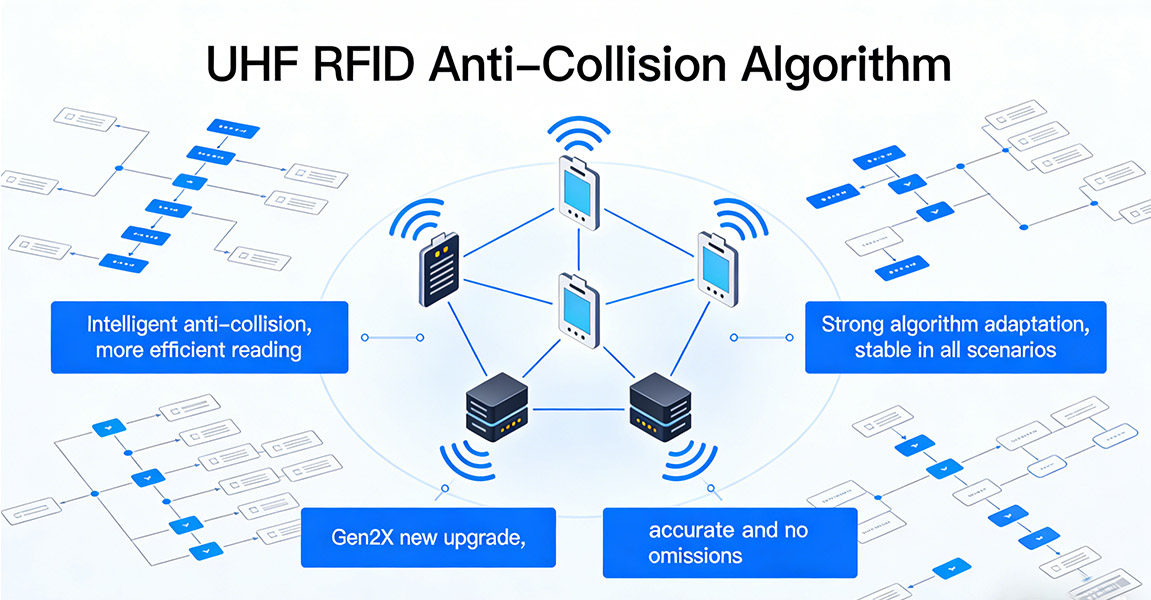
To keep data flowing smoothly, the industry has developed sophisticated anti-collision strategies. These solutions act like a traffic controller, ensuring each tag responds one at a time. They generally fall into two categories: collision avoidance and the emerging field of collision recovery.
1. Stochastic (Probabilistic) Solutions
The most widely used method in retail is the Slotted Aloha algorithm.
• The reader divides time into “slots” and asks tags to select a random slot to respond.
• Collisions may still occur, but most tags will pick unique slots, enabling reliable identification.
• It is easy to implement and performs well in moderately dense environments.
2. Deterministic (Tree-Based) Solutions
For scenarios requiring 100% accuracy, tree-walking or binary search protocols are used.
• The reader gradually narrows down tag IDs by grouping responses.
• By splitting tags into smaller subsets, it eventually isolates every single tag.
• This approach guarantees complete identification, making it ideal for mission-critical applications.
3. Power Level Tuning
If a reader attempts to read too many tags at once, collision rates rise sharply.
By reducing read range and output power, the reader communicates only with nearby tags, greatly reducing signal density and interference.
4. Physical Shielding and Antenna Orientation
Directional antennas focus RF signals like a flashlight instead of a lantern, confining reads to the target area. Proper tag placement also avoids coupling effects that block signals between closely stacked tags.
The Next Generation: Impinj Gen2X Technology
Traditional anti-collision methods work well, but modern retail demands more: denser tags, faster throughput, and reliable reads on liquids, metals, and small items. This is where Impinj Gen2X comes in.
As a standards-compatible enhancement to the GS1 UHF Gen2 standard, Gen2X delivers breakthrough performance for item-level RFID systems.
What Gen2X Brings to Anti-Collision
Gen2X operates as an intelligent “toolbox” that upgrades traditional anti-collision logic:
• Dynamic Q-Algorithms: Automatically adjust time slots in real time based on collision levels, speeding up dense inventory by up to 33%.
• Tag Decluttering & Selective Filtering: Allows readers to specify which tags respond, drastically reducing stray reads.
• Fast Reinventory: Efficiently rescans only relevant tags, improving speed and accuracy.
• Improved Sensitivity: Enhances reads on challenging items such as small tags, metal packaging, and liquid-filled products.
Industry Adoption and Compatibility
Gen2X is fully backward-compatible with legacy Gen2 devices, enabling smooth, incremental upgrades. Today, hundreds of Gen2X-enabled inlays and readers are available from global manufacturers, making it the new standard for high-performance RFID.
How SILION TECH Empowers Your RFID Deployment
As a long-term global partner of Impinj, SILION TECH integrates Gen2X technology across its full lineup of UHF RFID hardware, including:
• SIM3X00 / SIM5X00 / SIM7X00 series RFID modules
• Fixed and integrated RFID readers
• High-performance antennas and development kits
Our solutions leverage Gen2X to:
• Achieve faster inventory in high-density environments
• Reduce tag collision and missed reads
• Improve performance on metals, liquids, and small items
• Support Walmart-grade item-level tagging compliance
We help retail, logistics, and manufacturing customers turn tag collision from a bottleneck into a competitive advantage.
Conclusion
Tag collision is an inherent challenge in RFID, but it is entirely solvable.
With classic anti-collision algorithms and next-generation technology like Impinj Gen2X, businesses can achieve stable, fast, and accurate inventory visibility.
At SILION TECH, we don’t just supply hardware — we deliver end-to-end solutions that help you move from guessing inventory to knowing it precisely.