Your location: Home Page > RFID Blog | SILION TECH > RFID Warehouse Management Challenges: What You Must Know Before Implementation
News and Information
RFID Warehouse Management Challenges: What You Must Know Before Implementation
Author:2026-03-05 17:00:00
Warehouse management in the RFID sector is transforming global supply chains. From real-time inventory tracking to automated receiving and dispatch, RFID technology provides speed and visibility that traditional barcode systems cannot match. However, despite its powerful advantages, RFID warehouse management also comes with technical and operational challenges.
Understanding these challenges before implementation can help businesses reduce risk, control costs, and maximize return on investment (ROI). In this article, we will explore the most common RFID warehouse management challenges in simple, easy-to-understand language while covering all the important technical aspects.
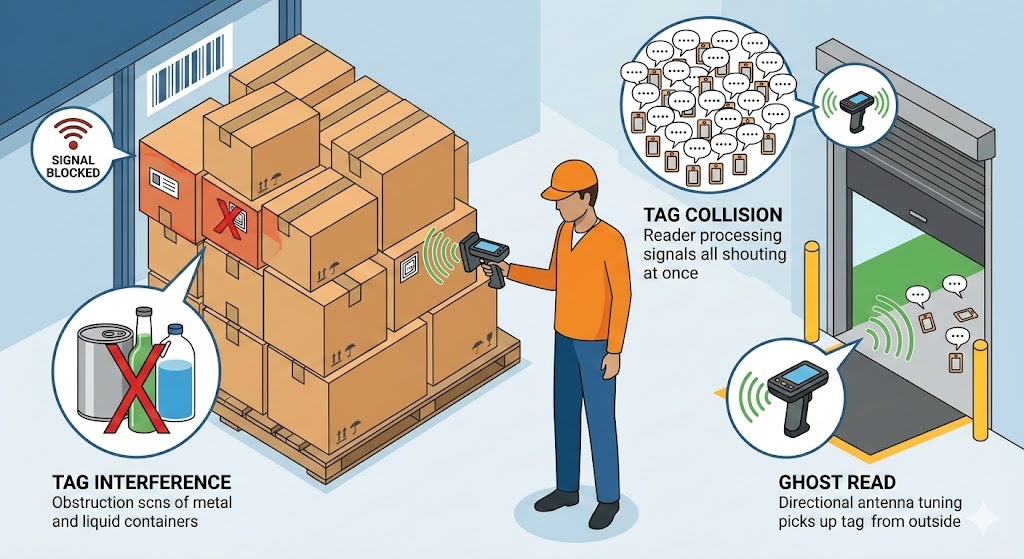
1. Signal Interference in Warehouse Environments
One of the most common technical issues in RFID-based warehouses is signal interference. RFID systems, especially UHF RFID, use radio waves to communicate between tags and readers. Warehouses often contain metal racks, steel containers, machinery, and liquid-based products. Metal reflects radio waves, while liquids absorb them. This creates signal attenuation and multipath interference, which can result in missed reads or inconsistent scanning.
To solve this issue, businesses must conduct a proper site survey before installation. Using anti-metal RFID tags, optimizing antenna placement, adjusting reader power levels, and deploying circularly polarized antennas can significantly improve read accuracy.
2. Tag Collision and Reader Collision
In large warehouses, thousands of RFID tags may be scanned simultaneously. When multiple tags respond simultaneously, a tag collision occurs. Similarly, when multiple readers interfere with each other, it causes a reader collision.
Although modern RFID systems follow EPC Gen2 anti-collision protocols, poor configuration (e.g., improper power setting, overlapping read zones) can still lead to incomplete data capture or slower reading speeds, such as incomplete data capture or slower reading speeds.
To minimize collision issues, warehouses should configure reader power carefully, use dense reader mode where required, and follow proper frequency management techniques.
3. High Initial Investment and Infrastructure Cost
Compared to barcode systems, RFID warehouse implementation requires a higher upfront investment. Costs include RFID tags, fixed readers, handheld readers, antennas, middleware software, and integration with ERP or WMS systems.
Additionally, hidden costs may include infrastructure upgrades, system customization, employee training, and maintenance.
However, when implemented correctly, RFID often delivers long-term savings through improved labor efficiency, reduced shrinkage, and better inventory accuracy. Starting with a pilot project focused on high-value inventory can help justify investment.
4. Integration with Existing Systems
Most warehouses already operate using ERP systems and Warehouse Management Systems (WMS). Integrating RFID data into these systems can be technically complex.
Common challenges include API compatibility, real-time data synchronization, and middleware configuration, whose core functions are data cleaning, format conversion, and protocol adaptation, which can deduplicate and correct errors of the original data collected by RFID readers, unify data formats, and achieve protocol compatibility with ERP and WMS systems to smooth the data transmission link.
Using reliable RFID middleware and working with experienced system integrators can ensure smooth integration and accurate data flow between systems.
5. Data Overload and Management Complexity
RFID systems generate large volumes of data. Every tag read creates information such as tag ID, timestamp, reader location, and event status. In large-scale operations, millions of read events can be generated daily.
Without proper data filtering and management, this can overload servers, increase storage requirements, and slow reporting systems.
To handle this challenge, companies should implement edge computing solutions and configure middleware to filter unnecessary read events. Cloud-based storage systems can also provide scalable data management.
6. Tag Durability and Environmental Conditions
Warehouse environments can be harsh. Extreme temperatures, dust, moisture, and physical impact can damage non-industrial grade RFID tags.
Not all RFID tags are designed for every application. For example, some tags are specifically built for high-temperature environments, outdoor use, chemical exposure, or metal surfaces.
Selecting the correct tag type based on application requirements is critical. Testing tags under real operating conditions before full deployment can prevent future failures.
7. Security and Data Privacy Risks
Because RFID systems use wireless communication, they introduce potential security risks. Unauthorized tag reading, data interception, and tag cloning are possible threats if systems are not properly secured.
To protect data, warehouses should use password-protected tag memory, encryption protocols, and secure network configurations. Role-based access control within the software system also enhances data security.
Security planning should always be part of an RFID warehouse deployment strategy.
8. Employee Training and Change Management
Technology implementation is not just about hardware and software; it also involves people. Employees may resist new systems if they find them complex or disruptive.
Without proper training, operational errors may increase, reducing system efficiency and ROI.
Providing structured training programs, hands-on demonstrations, and continuous technical support can ensure smoother adoption and better results.
9. Read Accuracy in Fast-Moving Operations
In high-speed warehouse operations such as conveyor belts or loading docks, maintaining read accuracy can be challenging. Fast-moving pallets and overlapping read zones may result in duplicate reads or missed items.
Proper reader calibration, optimized antenna positioning, shielding materials, and real-time testing are necessary to achieve 99% or higher inventory accuracy. RFID modules and readers based on the Impinj E710 chipset feature high-speed read/write performance and support Gen2X capabilities, ensuring superior read rates and anti-collision performance.
10. Regulatory and Frequency Compliance
RFID frequency bands and transmission power regulations vary by country. Using equipment that does not comply with local standards can cause legal issues and poor system performance.
Warehouses must ensure that RFID readers and tags are region-specific and certified according to local regulatory requirements.
RFID warehouse management offers significant benefits, including real-time inventory visibility, automation, reduced labor costs, and improved operational efficiency. However, challenges such as signal interference, integration complexity, data overload, and security risks must be carefully managed.
With proper planning, technical expertise, high-quality hardware, and ongoing optimization, RFID can transform warehouse operations into intelligent, automated systems.