Your location: Home Page > RFID Blog | SILION TECH > How Impinj Chips Differ and When to Use Each: E310 vs E510 vs E710 — A Complete Guide
News and Information
How Impinj Chips Differ and When to Use Each: E310 vs E510 vs E710 — A Complete Guide
Author:2026-06-18 15:30:00
E310 vs E510 vs E710 — A Complete Guide
Category: UHF RFID Technology | Tags: Impinj, RAIN RFID, UHF RFID Modules, E310, E510, E710
Introduction
When businesses and integrators evaluate UHF RFID solutions, one question comes up time and again: Which Impinj RAIN RFID reader IC should I build around? Impinj is the global leader in RAIN RFID silicon, and three of its most widely deployed reader chips — the E310, E510, and E710 — each serve distinct use cases. Choosing the right one can make the difference between a system that barely meets expectations and one that transforms operations.
This guide breaks down the technical differences between the Impinj E310, E510, and E710 chips, explains the strengths of each, and helps you match the right chip to your deployment — whether you are building a handheld scanner, a warehouse portal, or a high-throughput retail system.
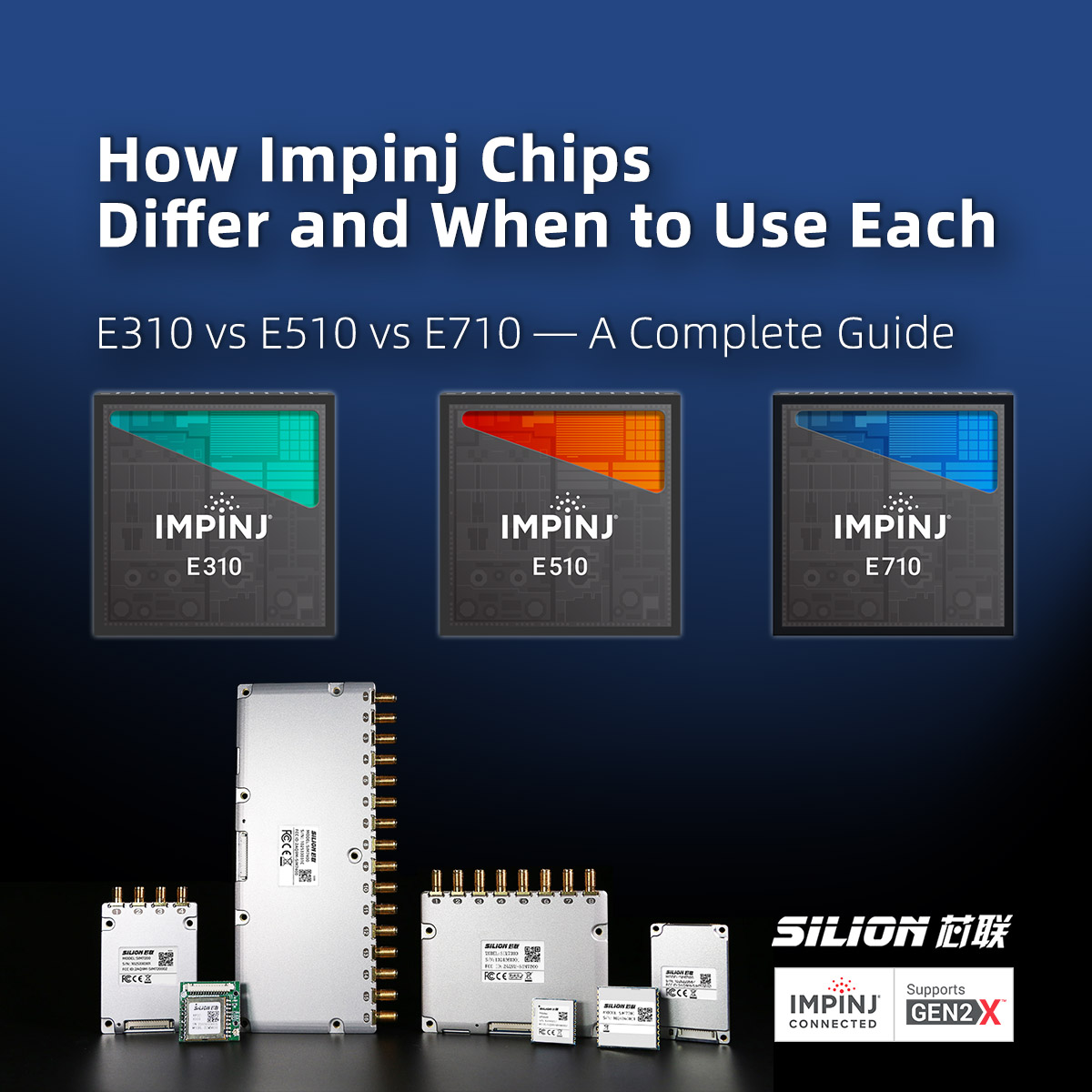
What Is Impinj and Why Do Its Chips Matter?
Impinj is the inventor of RAIN RFID and the world's leading provider of RFID reader and tag chips. Its reader ICs (integrated circuits) power the vast majority of UHF RFID modules on the market today, offering a reliable, high-performance foundation for RFID hardware manufacturers.
The E-series reader chips — E310, E510, and E710 — represent Impinj's current generation of RAIN RFID reader silicon. They follow the EPC Gen2 Version 2 / ISO/IEC 18000-63:2022 standard, ensuring compatibility across the global RAIN RFID ecosystem. Each chip is engineered for a different performance tier, and understanding those tiers is essential for anyone designing or sourcing an RFID solution.
Impinj E310: Compact, Cost-Effective, and Highly Portable
What Is the E310?
The Impinj E310 is an entry-to-mid-level RAIN RFID reader chip designed for space-constrained, power-sensitive, and cost-conscious applications. It delivers solid read performance in a small silicon footprint, making it the chip of choice for mobile and handheld RFID devices.
Key Technical Characteristics
• Compact IC size suited for ultra-small module designs
• Supports RF output up to 30 dBm depending on module implementation
• Low power consumption — ideal for battery-powered handhelds
• Single and dual antenna port configurations
• Good sensitivity for close-to-mid-range reading
• Supports EPC Gen2v2 and RAIN RFID standard protocols
When to Use the E310
The E310 is the right choice when:
• You need a compact RFID module for a handheld PDA or portable scanner
• Power efficiency is critical — mobile devices with limited battery life
• Budget sensitivity is a factor and high-volume tag reads are not required
• The application involves RFID printers requiring embedded reader capability
• You need a desktop or counter-top RFID reader with a small footprint
Silion Tech E310-Based Modules
Silion Tech manufactures several modules built on the E310 chip:
• SIM3800 — Ultra-compact at just 16.3mm x 16.3mm, SMD form factor, max 27 dBm RF output. Ideal for integration into PDAs and desktop RFID devices.
• SIM3100 — Single-port handheld module with MMCX antenna interface, up to 30 dBm output. Designed for mobile RFID readers.
• SIM3110 — 2-port module supporting tag RSSI acquisition, up to 26 dBm. Compatible with RFID printers and readers.
• SIM3200 — 4-port fixed reader module with SMA antenna interfaces, up to 30/33 dBm. Best value for cost-effective fixed RFID deployments.*
*up to 30 dBm native, expandable to 33 dBm with external power amplifier
Impinj E510: High Throughput for Fixed Infrastructure
What Is the E510?
The Impinj E510 is a next-generation RAIN RFID reader chip engineered for demanding fixed-reader applications. It significantly upgrades read throughput, antenna scalability, and RF performance compared to the E310, making it the backbone of warehouse portals, conveyor systems, and multi-antenna fixed installations.
Key Technical Characteristics
• Tag read speed exceeding 600 tags per second*
• 1–4 ports (expandable to 16 via external RF multiplexer)
• RF output up to 30 dBm
• Advanced anti-collision algorithm for dense tag environments
• High sensitivity for extended read ranges beyond 12 metres with appropriate antennas
• Silion’s E510 modules adopt large aluminium heat sinks for continuous high-duty-cycle operation
*600+ tags/s under standardized lab test without metal interference
When to Use the E510
The E510 is the right choice when:
• You are deploying a fixed RFID reader at a gate, dock door, or conveyor
• High tag volumes are expected — such as pallets, cartons, or apparel items moving at speed
• Multi-antenna coverage is required (8 or 16 zones from a single module)
• Read distances of 10–12+ metres are needed
• Industrial or warehouse environments demand reliable, continuous operation
• You need integration into existing IT infrastructure via standard interfaces
Silion Tech E510-Based Modules
Silion Tech's E510 lineup covers a wide range of fixed-reader requirements:
• SIM5100 — Single-port handheld/mobile module with MMCX interface, up to 30 dBm. Compact design for mobile fixed-mount use.
• SIM5200 — 4-port fixed reader module with SMA interfaces, up to 30 dBm. Excellent for dock doors and portals.
• SIM5300 — 8-port module with advanced anti-collision, 600+ tags/s, read range over 12m. Built for large-scale warehouse deployment.*
• SIM5400 — 16-port module — Silion's highest-capacity E510 module. Supports time-sharing across 16 antennas, 600+ tags/s, with superior heat dissipation via large aluminium thermal panel.*
*600+ tags/s under standardized lab test without metal interference.
Impinj E710: Maximum Performance for the Most Demanding Applications
What Is the E710?
The Impinj E710 is Impinj's flagship RAIN RFID reader chip, offering the highest read throughput, sensitivity, and capability in the current E-series range. It is designed for environments where tag density is extreme, read accuracy is mission-critical, and performance cannot be compromised.
Key Technical Characteristics
• Industry-leading read speeds up to 1,000 tags per second
• RF output up to 33 dBm
• Superior receiver sensitivity for challenging RF environments
• Advanced signal processing for high-accuracy tag identification
• Supports dense reader environments and complex multi-reader deployments
• Full RAIN RFID / EPC Gen2v2 compliance
When to Use the E710
The E710 is the right choice when:
• Your environment involves very high tag density — thousands of items in close proximity
• You need maximum read accuracy with minimal missed reads
• Applications include fashion retail with item-level tagging at checkout
• Pharmaceutical track-and-trace requires near-perfect read rates
• Smart manufacturing lines require rapid scanning of components
• Logistics hubs process high volumes of tagged parcels in tight time windows
• You need the best possible performance from a single-module deployment
Silion Tech E710-Based Modules
Silion Tech offers E710 modules built for high-performance fixed and enterprise deployments — delivering maximum throughput and sensitivity for the most demanding RFID environments.
Side-by-Side Comparison: E310 vs E510 vs E710
Feature | E310 | E510 | E710 |
Performance Tier | Entry-Level | Mid-Range | High-End |
Max RF Output | Up to 30/33 dBm | Up to 30 dBm | Up to 33 dBm |
Tag Read Speed | Standard | 600+ tags/s | 1,000+ tags/s |
Best Use Case | Handhelds, PDAs, Printers | Fixed readers, Gates, Portals | Dense/demanding environments |
Form Factor | Ultra-compact 16.3mm × 16.3mm SMD package | Compact to medium | Compact to medium |
Power Draw (Low = suitable for battery handheld; Medium-High = mains-powered fixed equipment) | Low | Medium | Medium-High |
*All throughput metrics are tested in open space without metal/liquid interference; actual on-site performance varies by tags and environment.
How to Choose the Right Chip for Your Project
Selecting the correct Impinj reader chip comes down to three key questions:
1. Is your device mobile or fixed?
Mobile and handheld devices — whether scanners, PDAs, or wearables — benefit from the E310's compact footprint and low power consumption. Fixed infrastructure applications demand the E510 or E710 for their throughput and antenna port count.
2. What is your expected tag volume and read speed?
If you are reading a few dozen items at a time, the E310 handles the task efficiently. If you need to process hundreds or thousands of items in seconds — as in a retail stockroom or logistics conveyor — the E510 or E710 is essential.
3. How demanding is your RF environment?
Challenging environments with metal, liquids, high tag density, or interference require better sensitivity and signal processing. The E710 excels in these conditions; the E510 handles most standard industrial environments well; and the E310 performs reliably in benign or controlled settings.
Matching Chips to Industry Use Cases
Retail — Item-Level Inventory
High-volume retail with thousands of tagged items on shelves and in stockrooms demands fast, accurate reads. The E710 is the preferred choice for item-level tagging at checkouts and stock takes, while the E510 works well for back-of-house portals and receiving docks.
Logistics and Warehousing
Dock door portals, conveyor lines, and inbound/outbound scanning require the E510's multi-antenna architecture and read throughput. For large distribution centres processing high parcel volumes, the E710 delivers the read reliability that operations depend on.
Manufacturing and WIP Tracking
Work-in-progress tracking on production lines benefits from the E510 in fixed-reader configurations. Where components are small, densely packed, or fast-moving, the E710 ensures no tag is missed.
Healthcare Asset Management
Hospitals tracking medical equipment, consumables, and pharmaceutical inventory often deploy handheld scanners (E310) for ward-level operations and fixed readers (E510) at storage rooms and dispensing areas.
Handheld and Mobile Applications
Field teams, store associates, and warehouse operatives using RFID PDAs and handheld scanners rely on E310-based modules. The compact size and battery efficiency translate directly to longer working shifts and lighter devices.
Frequently Asked Questions
Can I use an E310 module for a fixed reader application?
Yes, in lower-demand scenarios. Silion Tech's SIM3200, for example, is a 4-port fixed module based on the E310. It suits cost-sensitive fixed deployments where throughput requirements are moderate. For high-volume fixed applications, the E510 is recommended.
Is the E710 always better than the E510?
Not necessarily. The E710 delivers higher performance and costs more. For many standard fixed-reader applications — dock doors, gates, portals — the E510 provides outstanding performance at a better price point. The E710 makes sense when you need maximum throughput, superior sensitivity, or are operating in particularly challenging RF conditions.
Are Silion Tech modules compatible with standard RFID middleware?
Yes. Silion Tech modules support mainstream host communication interfaces such as RS232, alongside standard SMA/MMCX antenna connectors compatible with global RFID hardware ecosystems.
What read range can I expect from these modules?
Read range depends on antenna gain, the tag being read, and the environment. Silion Tech's E510-based modules such as the SIM5300 and SIM5400 achieve read distances of over 12 metres with an 8 dBi antenna in open conditions. E310-based mobile modules are typically optimised for shorter-range handheld applications.
Conclusion
The Impinj E310, E510, and E710 represent a well-structured progression in RAIN RFID reader capability. The E310 delivers compact efficiency for mobile and cost-sensitive deployments. The E510 scales to meet the demands of multi-antenna fixed infrastructure. The E710 pushes performance to its limit for the most demanding environments.
Selecting the right chip requires a clear understanding of your deployment environment, expected tag volumes, antenna architecture, and device form factor. By matching these requirements to the right Impinj reader IC, integrators and end users can build RFID systems that perform reliably from day one and scale as their operations grow.
About Silion Tech: Impinj Golden Partner
Silion Tech is a proud Impinj Golden Partner and one of the world's leading manufacturers of UHF RFID modules built on Impinj silicon. As a Golden Partner, Silion Tech has priority access to Impinj official technical documentation and pre-release chip roadmaps — ensuring that every module it develops represents the best of what RAIN RFID has to offer. Silion Tech's comprehensive UHF RFID module lineup spans all three Impinj reader chips covered in this guide: the E310 (available in the SIM3800, SIM3100, SIM3110, and SIM3200), the E510 (available in the SIM5100, SIM5200, SIM5300, and SIM5400), and the E710, covering everything from ultra-compact handheld modules to high-capacity 16-port fixed-reader solutions. Whether you are an OEM integrating an RFID module into a handheld device, a systems integrator designing a warehouse portal, or an enterprise deploying item-level RFID at scale, Silion Tech provides the module, the expertise, and the partnership to make your RFID project a success. Explore Silion Tech's full UHF RFID module range at en.silion.com.cn.
© Silion Tech | en.silion.com.cn | Impinj Golden Partner | UHF RFID Modules
Next Article:UHF RFID Output Power: 27 dBm, 30 dBm or 33 dBm?