Your location: Home Page > RFID Blog | SILION TECH > The Importance of RFID Development Boards in RFID Systems
News and Information
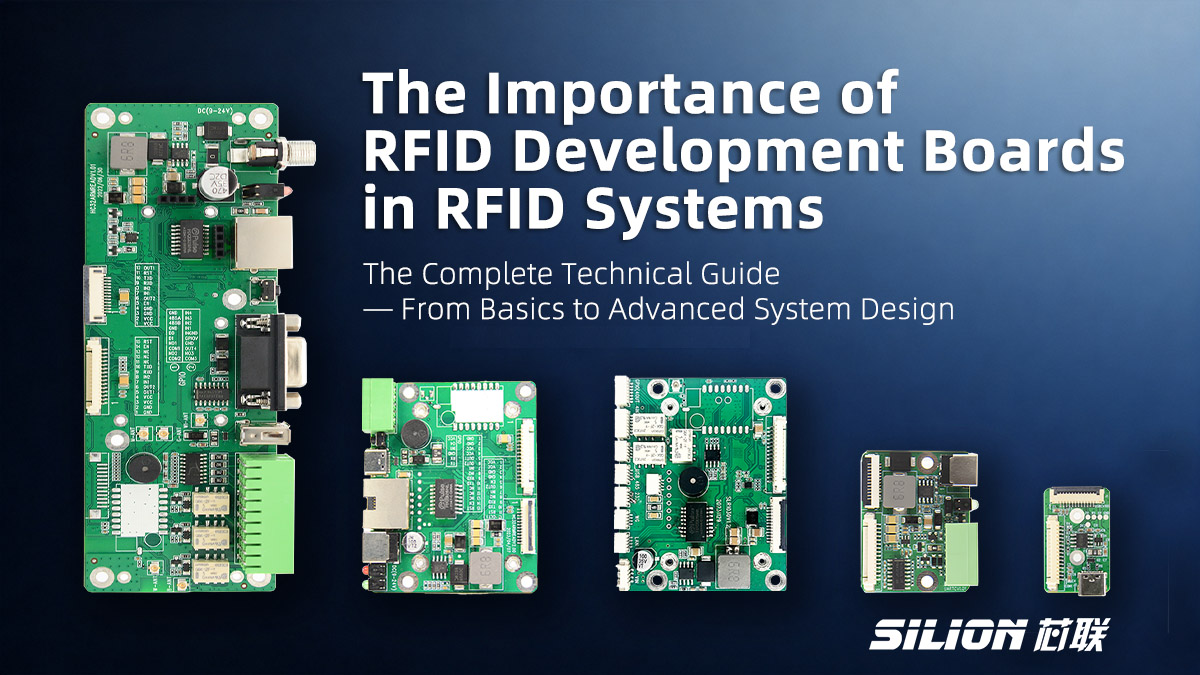
The Importance of RFID Development Boards in RFID Systems
Author:2026-06-10 12:00:00
The Complete Technical Guide — From Basics to Advanced System Design
What are RFID development boards? Why do engineers and developers use them? This comprehensive technical blog covers everything — from how RFID works at the physics level, to how development boards accelerate prototyping, system integration, and production deployment.
1. What Is RFID? A Technical Foundation
Radio Frequency Identification (RFID) is an Automatic Identification and Data Capture (AIDC) technology that uses electromagnetic fields to wirelessly read and write data stored on tags. Unlike barcodes, RFID does not require line-of-sight, enables simultaneous multi-tag reading, and can operate reliably in harsh environments such as metallic surroundings, humid conditions and low-visibility scenarios.
An RFID system consists of three fundamental components:
• RFID Tag (Transponder): A microchip bonded to an antenna, encapsulated in various form factors — labels, cards, wristbands, on-metal tiles, and more.
• RFID Reader (Interrogator): Generates an RF carrier wave, demodulates backscattered signals from tags, and decodes data. Can be fixed, handheld, or embedded.
• Host System / Middleware: Processes the data captured by the reader — typically a server, PLC, ERP, or WMS platform.
2. What Is an RFID Development Board?
An RFID development board (also known as an evaluation board or reference design board) is a purpose-built hardware platform that integrates an RFID reader IC, antenna matching network, RF front-end circuitry, and a host microcontroller or communication interface — all on a single PCB.
The primary purpose is to eliminate the complex RF engineering barriers between a software/firmware developer and a functional RFID system. Instead of designing a reader from scratch (including RF layout, impedance matching, regulatory compliance, and firmware development), engineers can leverage development boards to directly communicate with tags, verify software logic and test system integration.
Key Insight: An RFID development board is not just a prototyping tool — it is the fastest path from concept to production-ready RFID deployment.
Key Hardware Features and Their Engineering Value
Feature | Development Board Advantage |
GPIO Integration | Directly wire to sensors, motors, actuators, or relays |
UART / SPI / I2C | Flexible protocol support for any RFID IC |
Onboard Antenna Matching | Pre-tuned impedance networks reduce RF engineering effort |
USB / JTAG Debug | Real-time firmware inspection without external probes |
SDK & Example Code | Reduces time-to-prototype from weeks to hours |
Multi-reader Sync | Test daisy-chained or phased-array antenna configurations |
3. Core Purpose of RFID Development Boards
3.1 Rapid Prototyping and Concept Validation
The most immediate purpose of an RFID development board is to collapse the prototyping cycle. Hardware engineers can eliminate the 4–8 week cycle for PCB design and fabrication. Software developers can begin writing host application code on day one. System integrators can validate read range, antenna placement, and tag performance before committing to fixed infrastructure.
This directly reduces project risk and accelerates time-to-market — a critical advantage in competitive sectors like retail, healthcare, and logistics.
3.2 Firmware and Application Software Development
RFID development boards serve as the hardware target for:
• Reader Firmware: Developing custom reader command sequences, inventory algorithms, dense-reader mode configurations, and power level management.
• Host Application Logic: Writing tag data parsing, EPC/TID filtering, event-driven triggers, and database write-back logic.
• Anti-Collision Tuning: Testing EPC Gen2 Q-parameter algorithms, session flags (S0–S3) and tag singulation protocols for high-density tag environments.
• Protocol Stack Testing: Validating LLRP (Low Level Reader Protocol), SNMP (Simple Network Management Protocol), REST API (Representational State Transfer Application Programming Interface), MQTT (Message Queuing Telemetry Transport), and custom binary protocols.
3.3 RF Performance Characterization
Before deploying a fixed RFID infrastructure, engineers use development boards to characterize:
• Read Range vs. Transmit Power: Sweeping transmit (TX) power (0 dBm to +33 dBm) to determine the optimal operating point while complying with regional EIRP (Effective Isotropic Radiated Power) regulations.
• Antenna Radiation Pattern Mapping: Identifying coverage voids and multi-path interference zones.
• Tag Sensitivity Testing: Characterizing minimum readable tag RSSI and required field strength for passive tag wake-up.
• Dense Reader Environment Simulation: Testing channel hopping (FHSS), LBT (Listen Before Talk), and ETSI EN 302 208 and FCC Part 15 compliance.
3.4 System Integration and Middleware Testing
RFID development boards are the integration test platform for connecting the RFID hardware layer to enterprise systems:
• ERP Integration: SAP, Oracle, Microsoft Dynamics — validating RFID-triggered inventory transactions.
• WMS Integration: Testing real-time goods movement confirmation via RFID portal gates.
• IoT Platforms: Publishing tag reads to AWS IoT Core, Azure IoT Hub, or Google Cloud IoT via MQTT/AMQP.
• Edge Computing: Running local filtering, aggregation, and business logic on the development board's processor before cloud upload.
3.5 Regulatory and Certification Pre-Testing
RFID development boards with certified RF modules allow engineers to conduct pre-compliance testing before submitting to FCC (Federal Communications Commission, USA), CE (Conformité Européenne, Europe), MIC (Ministry of Internal Affairs and Communications, Japan) and SRRC (State Radio Regulation of China) certification bodies. This reduces certification iteration cycles and associated costs.
4. RFID Development Boards by Use Case
4.1 Supply Chain & Logistics
UHF RFID development boards are used to prototype portal gate readers, conveyor belt tunnel readers, and forklift-mounted RFID systems. Multi-antenna configurations are tested for 100% carton-level read accuracy. EPC Gen2 inventory algorithms are optimized for high-speed production lines (600+ cartons per hour).
4.2 Retail & Loss Prevention
HF and UHF development boards validate item-level tagging accuracy, EAS (Electronic Article Surveillance) integration, and fitting room smart mirror applications. Development boards with dense-reader protocol support are used for multi-reader floor deployments.
4.3 Healthcare & Pharmaceutical
HF RFID (ISO 15693) development boards are used for medication management, surgical instrument tracking, and blood bag identification — applications where read reliability and data integrity are critical. Anti-metal tag performance is characterized using development boards in controlled environments.
4.4 Access Control & Security
LF (125 kHz) and HF (13.56 MHz) development boards are used to develop and test credential readers, implementing Wiegand output protocol and OSDP (Open Supervised Device Protocol), and multi-technology card support.
4.5 Industrial IoT & Smart Manufacturing
RFID development boards interfacing with PLCs via OPC-UA, PROFINET, or Modbus TCP are used to prototype WIP (Work-In-Progress) tracking systems, tool management, and jig/fixture identification on production lines.
4.6 Animal Identification & Agriculture
LF RFID (ISO 11784/11785) development boards enable the development of livestock management readers, implant tag readers for veterinary applications, and farm asset tracking solutions.
5. Key Technical Parameters to Evaluate in an RFID Dev Board
When selecting an RFID development board, engineers should evaluate the following parameters:
• Supported RFID Standard: ISO/IEC 18000-63 (UHF EPC Gen2), ISO/IEC 14443 A/B (HF NFC/MIFARE), ISO/IEC 15693 (HF vicinity), and ISO 11784 / ISO 11785 (LF animal identification).
• Maximum Transmit Power: Higher TX power (up to +33 dBm for UHF) extends read range. Ensure regulatory compliance for target markets.
• Receiver Sensitivity: Higher receiver sensitivity (e.g., -80 dBm) allows the reader to detect weak backscattered signals from tags over longer distances.
• Anti-Collision Algorithm: EPC Gen2 supports simultaneous reading of up to 1,000 tags per second. Verify the development board's IC supports dense-reader Q-parameter adjustment.
• Number of Antenna Ports: 1, 2, 4, or 8 ports for multiplexed antenna coverage.
• Host Interface: USB, UART, SPI, Ethernet, Wi-Fi, Bluetooth — match to the target integration environment.
• SDK Completeness: Check for availability of C/C++, Python, Java, and .NET SDKs, plus LLRP support.
• Form Factor & Power Input: Evaluate for lab use (full-size PCB) vs. embedded deployment (compact module with PoE or battery input).
6. RFID Dev Board vs. Production Reader — When to Transition
A common question in RFID system development is when to move from a development board to a production-grade fixed reader. The answer depends on the maturity of the firmware, the integration completeness, and regulatory readiness.
Development Board Phase | Production Reader Phase |
Proof of Concept | Pilot & Scale Deployment |
Algorithm & firmware development | Locked firmware, field tested |
Tag & antenna selection | Certified antenna, enclosure IP-rated (Ingress Protection-rated) |
Integration API development | Full ERP/WMS integration is live |
Pre-compliance RF testing | FCC/CE/SRRC certified |
Engineering team environment | Production operations environment |
7. Common RFID Development Board ICs and Chipsets
The reader IC is the heart of any RFID development board. Understanding the chip determines the board's maximum capability:
• Impinj E710 (replacement for Indy R2000) and Impinj E310 (replacement for Indy R500): Next-generation RAIN RFID SoCs with enhanced sensitivity, lower power consumption, and native EPC Gen2X protocol support (enhanced for anti-counterfeiting and data privacy). They maintain full compatibility with the Octane SDK and are widely adopted in embedded modules, handheld readers, and third-party enterprise RFID devices.
• Silion SLD1010: High-performance UHF reader IC with integrated MCU support, used in Silion's developer modules and enterprise readers.
8. Software Ecosystem and SDKs for RFID Development Boards
A development board is only as powerful as its software ecosystem. Key software components engineers should look for:
8.1 Reader Firmware
The firmware running on the development board's host processor handles EPC Gen2 command sequencing (Select, Query, QueryRep, ACK, ReadData, WriteData), power control, frequency hopping, and communication protocol encoding/decoding.
8.2 Host SDKs
Most RFID reader manufacturers provide multi-language SDKs. Production-grade SDKs include:
• Impinj Octane SDK: .NET, Java, Python, C++ — full LLRP wrapper with event-driven tag report callbacks.
• Silion Reader SDK: Platform-specific SDKs with direct register-level access for custom firmware development.
8.3 LLRP (Low Level Reader Protocol)
LLRP (ISO/IEC 24971-1 / EPCglobal Low Level Reader Protocol) is the standard XML-based protocol for configuring and controlling RFID readers over TCP/IP. All enterprise-grade RFID development boards support LLRP, enabling vendor-agnostic reader management software.
8.4 REST API / MQTT Interfaces
Modern RFID development boards with onboard Wi-Fi or Ethernet support RESTful HTTP APIs, and MQTT publish/subscribe for direct IoT platform integration — enabling tag read events to trigger cloud workflows without a local middleware server.
9. Best Practices for RFID Development Board Deployment
• Always validate RF performance in the target environment — materials, metal, and liquids significantly affect read range.
• Start with the maximum allowed TX power and reduce incrementally to minimize interference and false reads in production.
• Use a spectrum analyzer to identify interference sources before finalizing antenna placement.
• Implement tag filtering (EPC mask, RSSI threshold) in firmware to eliminate ghost reads and weak-field detections.
• Log raw RSSI values during development — this data is essential for antenna pattern optimization and post-deployment diagnostics.
• Validate tag orientation sensitivity — Planar dipole tags (This is a common RF characteristic for passive UHF tags) show poor signal reception in the broadside direction; circular polarization antennas mitigate this.
• Perform multi-reader EAS (Electronic Article Surveillance) and dense-reader mode testing before go-live in environments with more than two co-located readers.
• Use the development board to validate anti-collision performance with live tag populations — bench testing with a few tags does not represent production conditions.
10. The Future of RFID Development: Trends and Emerging Standards
RFID development boards are evolving alongside the broader technology landscape:
• RAIN RFID (UHF EPC Gen2 rebranded by RAIN Alliance): Cloud-connected, internet-of-things-oriented UHF RFID — development boards now ship with native cloud SDK integrations.
• NFC / RFID Convergence: Dev boards supporting both ISO 14443 (NFC) and ISO 15693 (RFID) enable hybrid consumer-facing and logistics applications.
• AI-Enabled Edge Processing: Dev boards with onboard NPUs (Neural Processing Units) enable on-device anomaly detection, predictive maintenance, and intelligent tag filtering.
• RFID + Sensor Fusion: BAP (Battery-Assisted Passive) tags with onboard temperature, humidity, and shock sensors are being prototyped on multimodal development boards for pharmaceutical cold chain monitoring.
• Sub-GHz RFID & Bluetooth Low Energy (BLE) Hybrid Tags: New development boards test multi-protocol tags that respond to both UHF RFID readers and BLE scanners.
• RFID + Computer Vision: Development platforms combining RFID development boards with camera modules enable hybrid item identification — a growing trend in smart retail.
POWER YOUR RFID PROJECT WITH SILION TECH
Silion Tech is your end-to-end partner for RFID development boards and complete RFID solutions.
From compact UHF developer modules and multi-port evaluation boards to enterprise-grade fixed readers, Silion Tech offers hardware designed for engineers who demand performance, flexibility, and rapid integration.
Whether you are building a retail inventory system, a smart warehouse portal, an industrial IoT application, or an access control platform — Silion Tech development boards give you the RF horsepower and SDK ecosystem to ship faster.
Silion Tech RFID development boards are trusted by engineers across retail, logistics, healthcare, and manufacturing — backed by full technical support, comprehensive SDKs, and a global distribution network.
Visit Silion Tech today to explore our full range of RFID development boards, evaluation kits, reader modules, and turnkey RFID solutions — and accelerate your journey from prototype to production.
en.silion.com.cn | sales@silion.com.cn
Tags: RFID Development Board | UHF RFID | RFID Reader IC | EPC Gen2 | RFID Prototyping | RFID SDK | Silion Tech | RFID Solutions | IoT RFID | RAIN RFID