Your location: Home Page > RFID Blog | SILION TECH > How Banks Use Passive UHF RAIN RFID to Stop Internal Physical Asset Theft
News and Information
How Banks Use Passive UHF RAIN RFID to Stop Internal Physical Asset Theft
Author:2026-07-14 17:00:00
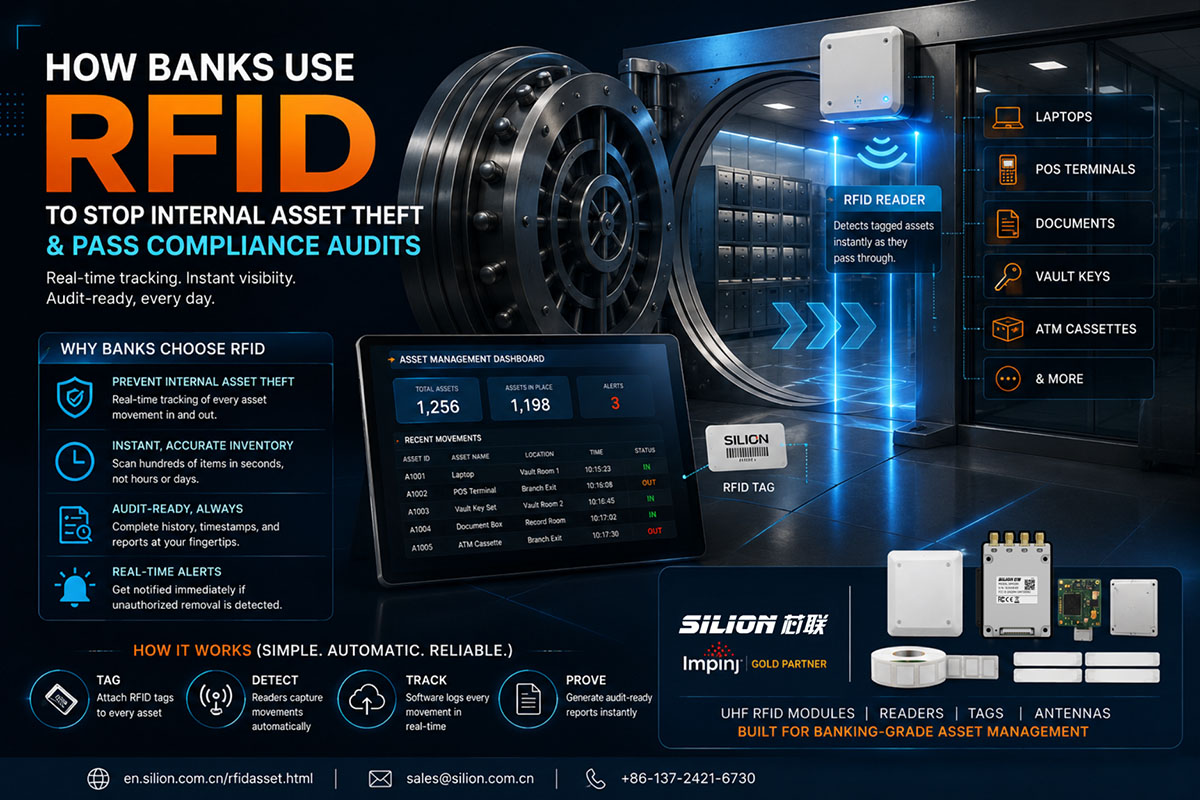
The Real Problem: Why Banks Lose Physical Assets From the Inside
Every bank keeps a mountain of physical items that aren't cash but are just as sensitive: laptops, POS terminals, safe deposit keys, signed documents, checkbooks, ATM cassettes, server hardware, even branded promotional items. On paper, someone signs a register every time one of these physical assets moves. In practice, registers get skipped, items go missing for months before anyone notices, and when the internal auditor finally asks where a specific physical asset is, nobody has a clear, verifiable answer.
This is not a minor operational risk. It is one of the most recurring findings in internal bank audits, and it is also one of the easiest to resolve — not by adding more manual paperwork, but by deploying Passive UHF RAIN RFID.
Banks rarely suffer mass physical asset loss from external break-ins. Instead, physical assets disappear gradually from within the branch, driven by three persistent procedural weaknesses:
• No continuous real-time visibility of physical asset custody. Paper logbooks only reflect manually recorded entries, not the actual real-world location of each item.
• Fully manual audit stocktakes. Staff must walk through vaults and storage rooms to count items visually, a process that takes multiple business days and carries a high risk of human counting error.
• No automatic notification of unauthorized physical asset removal. If an item is quietly taken out of restricted areas, the team receives no alert until the next scheduled quarterly or annual count, which could be months later.
The cumulative outcome: a measurable share of physical assets go unaccounted for each year, audit records contain unexplained inventory discrepancies, and compliance teams flag identical procedural gaps year after year.
What Passive UHF RAIN RFID Actually Is (Explained Simply)
Passive UHF RFID asset labels (including tamper-proof hard labels and adhesive stickers) store a unique radio chip ID. Unlike linear barcodes, they do not require a scanner to be aimed directly at the label surface. When affixed to a physical asset, each label transmits its unique identifier whenever a UHF RAIN RFID reader is within detection range.
A complete Passive UHF RAIN RFID system consists of three core components:
1. Passive UHF RFID asset label – Affixed permanently to each physical asset, pre-programmed with an exclusive unique identification number.
2. UHF RAIN RFID reader & matched antenna – Mounted at doorways, vault entrances and storage shelving; it captures label data via radio waves without requiring unobstructed line of sight, unlike barcode scanners.
3. Central asset management software – Automatically logs every label detection event, recording the corresponding physical asset, exact detection location, and precise timestamp.
No manual data entry is required at any stage, and staff do not need to remember to complete registration forms. The moment a tagged physical asset passes within the coverage zone of a UHF RAIN RFID reader, the system automatically captures and stores its movement record.
How Passive UHF RAIN RFID Eliminates Internal Physical Asset Theft
Internal theft of bank physical assets differs from external break-ins: staff removing items often hold legitimate access credentials for vaults and storage areas. Physical door locks cannot track which specific physical assets leave the room — only Passive UHF RAIN RFID generates an immutable, automated movement log for full traceability.
All physical asset movements are recorded without human intervention. Once fitted with a passive UHF RFID asset label, an item passing through a vault or storage exit will be detected by the UHF RAIN RFID reader, even when concealed inside bags, thanks to radio wave penetration that barcodes cannot match.
Missing physical assets are flagged the same day they disappear, rather than waiting months for scheduled counts. The system maintains a pre-set inventory baseline for each storage zone and immediately highlights inventory shortfalls.
Every log entry is linked to a precise timestamp and location marker. If a physical asset goes missing, auditors do not need to interview all staff; the system narrows the investigation to a specific shift and physical zone.
Unauthorized removal of high-value physical assets can trigger a real-time exception alert. UHF RAIN RFID readers can be configured to activate instant system notifications if restricted items exit monitored doorways without pre-approved digital authorization.
How Passive UHF RAIN RFID Simplifies Regulatory & Internal Compliance Audits
Regulators and internal audit teams consistently focus on three core questions: What physical assets does the institution hold? Where is each physical asset located? Can you provide verifiable proof? Passive UHF RAIN RFID answers all three without extra manual labor.
• Instant, high-accuracy bulk stocktakes. A handheld UHF RAIN RFID reader can scan an entire storage room or vault shelf within seconds, reading hundreds of passive UHF RFID asset labels simultaneously under open-space, low-interference lab test conditions.
• Complete lifecycle movement records for every physical asset. Auditors are not required to rely on handwritten logbooks; the system generates a full timestamped audit trail starting from the moment each physical asset is affixed with a passive UHF RFID asset label.
• Frequent early detection of inventory mismatches. Physical assets are tracked continuously, rather than only counted quarterly, so minor discrepancies are resolved long before formal audits.
• Exportable tamper-evident audit logs & standardized compliance reports. Compliance teams can generate fully system-verified documentation directly from the RFID platform, eliminating the need to manually compile fragmented records.
For banking institutions, this transforms labor-intensive multi-day manual audits into a streamlined same-day compliance validation process — all audit evidence is captured automatically throughout the year, rather than rushed together shortly before inspection deadlines.
What a Typical Bank Physical Asset Tracking Deployment Looks Like
A standard Passive UHF RAIN RFID rollout requires no full demolition or replacement of existing on-site infrastructure. Implementation follows four clear stages:
1. Deploy passive UHF RFID asset labels on high-value, high-risk physical assets first: cash processing equipment, IT server hardware, confidential signed documents, and vault inventory.
2. Install fixed UHF RAIN RFID readers at critical control points: vault entry/exit doors, storage room entrances, and main branch exit lanes.
3. Equip storage and vault staff with handheld UHF RAIN RFID readers for rapid ad-hoc shelf spot checks.
4. Integrate the RFID platform with the bank’s existing physical asset register, enabling automatic record updates upon each UHF RAIN RFID reader scan instead of maintaining disconnected separate systems.
Passive UHF RFID asset labels and UHF RAIN RFID readers are now widely available at accessible price points, making single-vault or single-branch pilot deployments viable before rolling the solution out bank-wide.
Note: Standard passive UHF RFID asset labels experience signal attenuation when mounted directly onto metal surfaces. Anti-metal optimized RFID labels are recommended for steel vault fixtures, metal POS hardware, and metal storage cabinet inventory.
Frequently Asked Questions
Does Passive UHF RAIN RFID replace the bank’s existing physical security systems?
No. Passive UHF RAIN RFID does not replace CCTV surveillance, door access control hardware, or vault physical locks. It adds a dedicated automated asset tracking layer on top of existing security tools, delivering item-level visibility of every physical asset — a granular tracking capability standalone cameras cannot provide.
Can staff remove or tamper with passive UHF RFID asset labels to hide missing physical assets?
Standard adhesive passive UHF RFID asset labels cease signal transmission once peeled away. Tamper-proof hard asset labels sever their internal chip circuit upon removal, triggering immediate system exceptions. In both scenarios, the audit log will show the physical asset was detected up to a specific timestamp before all signals ceased, creating an automatic investigation trigger rather than allowing silent, untraceable loss.
Is Passive UHF RAIN RFID cost-prohibitive for a single branch pilot?
A pilot deployment covering one vault or single branch represents a modest capital outlay when weighed against the financial losses caused by recurring unaccounted physical assets. Most banks adopt phased rollouts instead of full institution-wide installation on day one.
How does Passive UHF RAIN RFID differ from barcode tracking already used in banks?
Barcodes require manual one-by-one scanning with direct unobstructed line of sight. UHF RAIN RFID readers automatically capture data from dozens of passive UHF RFID asset labels simultaneously without on-site staff involvement.
The Bottom Line
Internal physical asset loss within banking environments rarely stems from high-profile break-ins. It develops slowly, hidden within gaps in fully manual tracking workflows. Passive UHF RAIN RFID resolves these procedural weaknesses entirely: it eliminates error-prone manual registration steps, generates permanent timestamped audit trails for every physical asset, and transforms labor-intensive manual compliance audits into complete, verifiable same-day audit reports. For multi-branch banks managing large volumes of sensitive equipment and confidential paperwork, Passive UHF RAIN RFID is no longer an optional technology upgrade — it is an essential operational risk safeguard.
About Silion Tech
Silion Tech is an official Impinj Gold Partner, supplying UHF RAIN readers, passive UHF RFID asset labels and matched antennas for physical asset management deployments across banking, retail, logistics and manufacturing sectors. Explore our full asset tracking solutions via en.silion.com.cn/rfidasset.html