Your location: Home Page > RFID Blog | SILION TECH > Turnkey RFID Partner Solution vs. Custom Module Integration: How to Choose the Right RAIN RFID Deployment Path
News and Information
Turnkey RFID Partner Solution vs. Custom Module Integration: How to Choose the Right RAIN RFID Deployment Path
Author:2026-07-21 19:00:00
Introduction: The Question Every RFID Buyer Eventually Asks
If you have started researching RAIN RFID for your business, you have probably run into two very different paths. The first is buying a turnkey RFID system — a complete, ready-to-use solution from an established RFID partner. The second is building your own system by sourcing UHF RFID modules, antennas, and readers, and integrating them yourself or with the help of a hardware manufacturer.
Both paths work. Both are used every day by real companies — from hospitals tracking surgical equipment to warehouses verifying shipments. The optimal selection does not boil down to which option is universally "better" but relies more on your team's technical resources, timeline, budget, and long-term product goals. This guide breaks the decision down in plain language, with just enough technical detail to help you ask the right questions.
Whether you are completely new to RFID or already comparing UHF RFID reader modules, this article will help you decide with confidence.
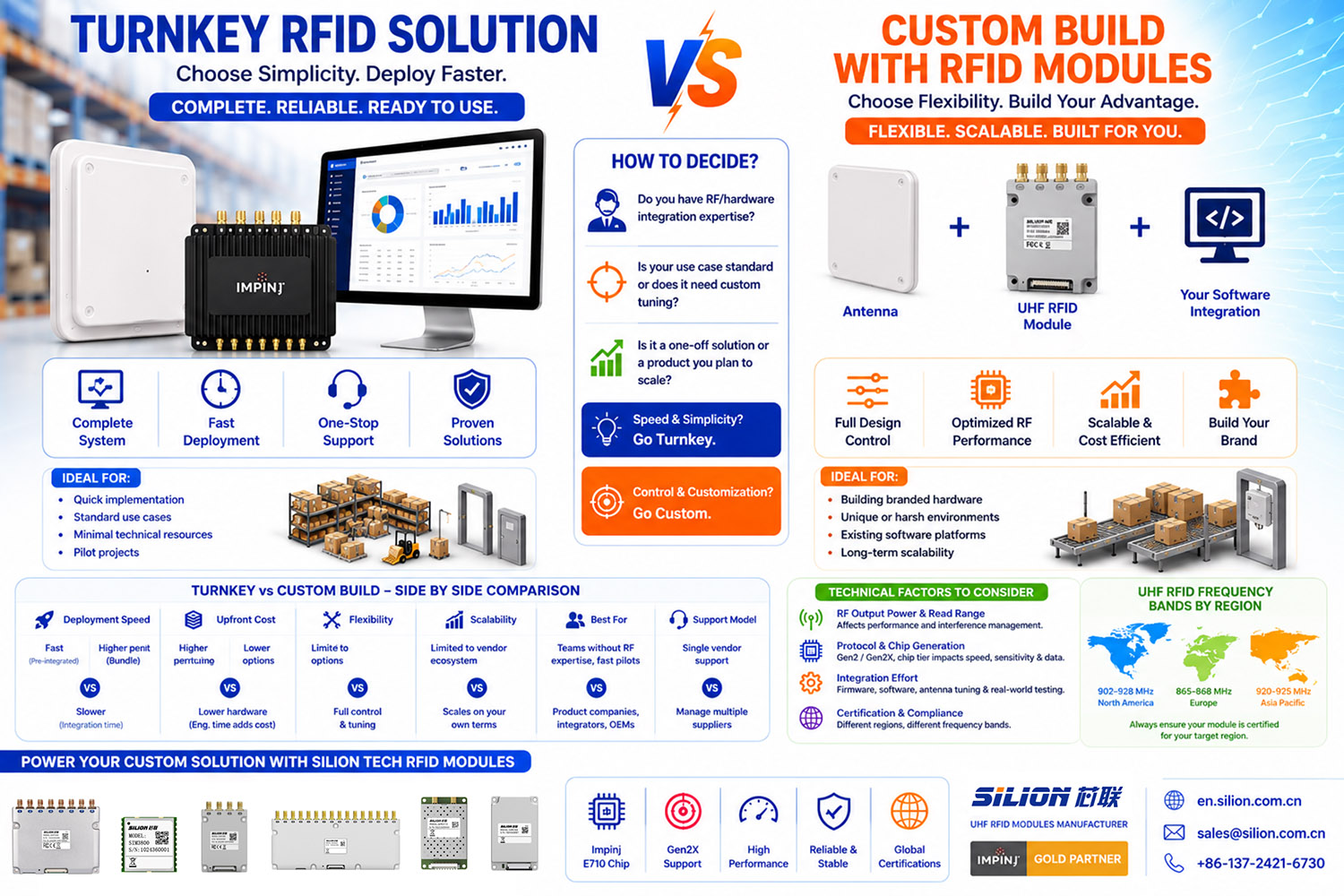
What Is a Turnkey RFID Partner Solution?
A turnkey solution is a complete system built by an RFID solution provider — sometimes called an Impinj Certified Partner or Impinj Gold Partner — that combines hardware, software, and support into one package. You typically get:
• Pre-configured readers, antennas, and tags
• Software or middleware for data collection and reporting
• Installation guidance and after-sales support
• A solution designed for a specific use case, such as inventory management, loss prevention, or asset tracking
Think of it like buying a fully built computer rather than assembling one from parts. You lose some flexibility, but you gain speed and simplicity — which matters a lot if your team has never worked with RFID before.
What Does "Integrating Your Own Modules" Actually Mean?
Custom-building means sourcing individual RFID components — usually a reader module (such as an Impinj-powered UHF RFID module), an antenna, and a housing or enclosure — and integrating them into your own product or workflow. This path is common for:
• Hardware manufacturers building a branded device (handheld scanner, fixed reader, kiosk, etc.)
• System integrators who need RF performance tuned to a specific environment
• Companies that already have software and simply need reliable RF hardware to plug into it
This is the path where a manufacturer like Silion Tech comes in — supplying UHF RFID modules across different form factors (miniature SMT, 1/2-port, integrated antenna, and 4/8-port modules) that integrators and OEMs build into their own products.
Turnkey vs. Custom Build: Side-by-Side Comparison
Here is a simple breakdown to help you compare the two approaches at a glance:
Factor | Turnkey Partner Solution | Custom Module Build |
Deployment speed | Fast — pre-integrated hardware, software, and support | Slower — requires design, testing, and integration time |
Upfront cost | Higher per-unit cost, bundled services | Lower hardware cost, but engineering time adds cost |
Flexibility | Limited to what the vendor offers | Full control over antenna, enclosure, firmware, and RF tuning |
Scalability | Easy to scale within the vendor's ecosystem | Scales on your own terms, but you own the roadmap |
Best for | Teams without in-house RF/hardware expertise, or fast pilots | Product companies, integrators, and OEMs building a branded device |
Support model | Single vendor, one support contract | You coordinate multiple component suppliers (RFID module, external antenna, metal/plastic enclosure, power supply) |
The Technical Side: What Actually Changes Under the Hood
This section gets a little more technical — but understanding these basics will help you have a smarter conversation with any vendor.
1. RF Output Power and Read Range
Turnkey systems are pre-tuned for their intended environment, so you rarely need to think about RF output power settings. With a custom build, you choose the module and configure output power (commonly measured in dBm) yourself, which directly affects read range and reader-to-reader interference in dense deployments. All Silion SIM-series modules support software-adjustable RF output power from 27 dBm up to 33 dBm to match regional EIRP/ERP regulatory caps.
2. Protocol and Chip Generation
Most modern UHF RFID hardware runs on the EPC Gen2 / Gen2X standard, but tag IC generation (older Monza series inlays vs latest M700/M800 high-performance tag chips) affects read speed, sensitivity, and data storage capacity.
3. Integration Effort
A turnkey system usually connects to its own software with minimal setup. A custom build requires integration work — writing firmware, connecting to your own database or ERP, and testing the antenna/enclosure combination in real-world conditions (metal shelving, liquids, or dense stacking all affect performance).
4. Certification and Regional Compliance
UHF RFID operates on different frequency bands depending on region (for example, 902–928 MHz in North America versus 865–868 MHz in Europe). Turnkey vendors typically handle full regional compliance certification for finished systems. Custom builders need to confirm the module they choose is certified for target regions, and complete full-device compliance testing separately.
Note: Module certification alone does not replace full-device radio, EMC, safety, and RoHS compliance testing required for finished OEM hardware sold globally under FCC, EU RED, and local radio regulations.
When a Turnkey Partner Solution Makes Sense
• You need a working system fast, with minimal in-house technical staff
• You want a single point of contact for support and warranty
• Your use case matches a common, well-established application (retail inventory, loss prevention, asset tracking)
• You are running a pilot project and want to prove ROI before investing further
When Building with Your Own Modules Makes Sense
• You are building your own branded hardware product (a scanner, kiosk, or embedded device)
• Your use case is unusual enough that off-the-shelf solutions don't fit well (unique enclosure size, harsh environment, or custom read range requirements)
• You already have software or a platform and only need reliable RF hardware
• You want long-term cost control and the flexibility to switch or scale components independently
A Simple Decision Framework
If you are still unsure, ask yourself these three questions:
• 1. Do I have (or can I hire) someone who understands RF hardware and firmware integration?
• 2. Is my use case standard, or does it need custom tuning for range, size, or environment?
• 3. Am I building a one-off internal solution, or a product I plan to sell or scale?
If your answers point toward speed and simplicity, a turnkey partner solution is usually the safer bet. If your answers point toward control, customization, or building your own product line, sourcing UHF RFID modules directly from a manufacturer gives you more room to grow.
Frequently Asked Questions
Is a turnkey RFID system more expensive than building my own?
Usually the per-unit hardware cost is higher because it includes software and support. But when you factor in engineering time, testing, and troubleshooting, a custom build isn't automatically cheaper — it depends on your team's existing expertise.
Can I switch from a turnkey solution to a custom build later?
Yes. Many companies start with a turnkey pilot to prove the use case, then move to a custom build once they understand their exact requirements and want more control over cost or design.
Do I need to be an RF engineer to integrate RFID modules myself?
Not necessarily. Most UHF RFID module manufacturers provide reference designs, SDKs, and technical support to help integrators without deep RF backgrounds get started.
What is an Impinj Gold Partner, and why does it matter?
It is a certification level within the Impinj Partner Network that recognizes companies with proven expertise in designing and delivering RAIN RFID solutions — whether that's a turnkey solution or reliable hardware modules for integrators.
There is no universally "right" choice between a turnkey partner solution and a custom module build — only the right choice for your project. Turnkey solutions win on speed and simplicity. Custom builds win on flexibility and long-term control. Understanding the basics of RF output power, chip generation, and integration effort will help you make that decision with confidence, whichever path you choose.
Looking for reliable UHF RFID modules to power a custom build? Explore Silion Tech's full SIM-series RFID portfolio: ultra-small SMD embedded modules (SIM3800), 1/2-port handheld modules, and high-channel 4/8/16-port industrial multi-antenna readers built on Impinj E310/E510/E710 ICs.