Your location: Home Page > RFID Blog | SILION TECH > Fixed RFID Reader vs Handheld RFID Reader: Which One Should You Choose?
News and Information
Fixed RFID Reader vs Handheld RFID Reader: Which One Should You Choose?
Author:2026-08-13 17:57:31
Fixed RFID Reader vs Handheld RFID Reader: Complete Comparison Guide for System Integrators (2026)
Fixed RFID Reader vs Handheld RFID Reader: A Complete Guide for RFID System Integrators
Selecting the right RFID reader is one of the most important decisions when designing an RFID solution. Whether you’re building a warehouse automation system, deploying retail inventory management, or integrating RFID into industrial manufacturing, your choice between a Fixed RFID Reader and a Handheld RFID Reader directly impacts system performance, scalability, and return on investment.
Although both reader types use the same UHF RAIN RFID technology to identify EPC Gen2 tags, they serve very different purposes. Fixed readers are designed for continuous, automated tag detection in predefined locations, while handheld readers provide mobility and flexibility for manual inventory operations.
This guide compares Fixed RFID Readers and Handheld RFID Readers from both a technical and operational perspective, helping RFID system integrators, OEMs, and solution providers choose the right solution for their projects.
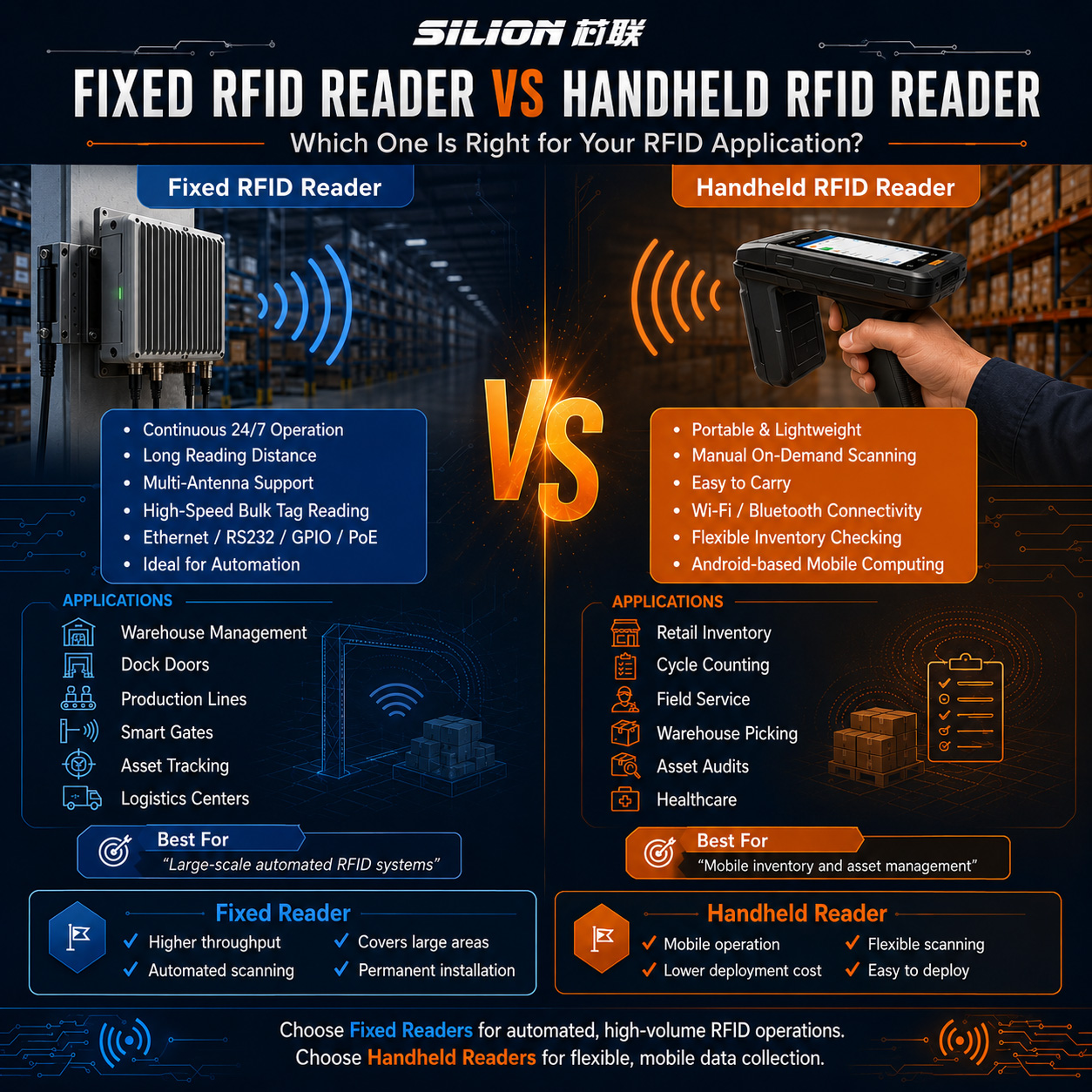
Quick Answer
Choose a Fixed RFID Reader if you need:
· Automated RFID scanning
· 24/7 operation
· High-volume tag reading
· Warehouse automation
· Conveyor systems
· Dock door portals
· Smart shelves
· Production lines
Choose a Handheld RFID Reader if you need:
· Mobile inventory counting
· Asset auditing
· Retail stock checks
· Field inspections
· Warehouse picking
· On-demand scanning
· Flexible deployment
Fixed RFID Reader vs Handheld RFID Reader: Quick Comparison
Feature | Fixed RFID Reader | Handheld RFID Reader |
Installation | Permanent | Portable |
Mobility | None | High |
Operation | Automatic | Manual |
Power Source | External Power | Rechargeable Battery |
Reading Mode | Continuous | Trigger-Based |
Multi-Antenna Support | Yes | Usually limited to a single integrated antenna (external antenna expansion optional on high-end industrial PDAs) |
Reading Capacity | Very High | Moderate |
Automation | Excellent | Limited |
Warehouse Gates | Excellent | Not Ideal |
Inventory Counting | Good | Excellent |
Production Lines | Excellent | Limited |
Retail Stores | Good | Excellent |
Cost | Higher Initial Investment | Lower Initial Investment |
Both reader categories can leverage Gen2X fast inventory algorithms to boost dense-tag reading efficiency when paired with compatible Impinj-based RFID modules.
What Is a Fixed RFID Reader?
A Fixed RFID Reader is a permanently installed RFID device that continuously scans RFID tags without requiring human intervention.
It is commonly mounted at:
· Warehouse dock doors
· Conveyor belts
· Manufacturing lines
· Smart cabinets
· Retail entrances
· Automated storage systems
· Vehicle checkpoints
· Smart shelves
Once installed, the reader automatically detects tagged items as they move through its read zone.
Instead of an employee walking around with a scanner, the system captures RFID data automatically, making it ideal for high-volume environments.
Advantages of Fixed RFID Readers
1. Continuous Operation
Fixed readers operate 24 hours a day, automatically reading tags whenever they enter the antenna coverage area.
No manual scanning is required.
2. Higher Throughput
Industrial fixed readers can process hundreds or even thousands of RFID tags within seconds, depending on the application and reader configuration.
This makes them suitable for:
· Warehouse portals
· Logistics hubs
· Distribution centers
· Manufacturing facilities
3. Multiple Antenna Support
Unlike handheld devices, fixed readers often support multiple antennas.
For example:
· 2-port readers
· 4-port readers
· 8-port readers
· 16-port readers
Multiple antennas enable complete coverage of larger read zones while reducing blind spots.
4. Seamless System Integration
Fixed RFID readers can integrate with:
· Warehouse Management Systems (WMS)
· Enterprise Resource Planning (ERP)
· Manufacturing Execution Systems (MES)
· Access Control Systems
· Industrial IoT Platforms
This allows real-time visibility into inventory movement and asset status.
Fixed RFID readers support standard communication interfaces (TCP/IP, RS232, RS485) for seamless integration with WMS, ERP, MES and industrial IoT platforms.
5. Ideal Applications
Fixed RFID readers are widely used for:
· Warehouse automation
· Logistics
· Manufacturing
· Asset tracking
· Smart factories
· Retail automation
· Vehicle identification
· Smart parking
What Is a Handheld RFID Reader?
A Handheld RFID Reader is a portable RFID device that combines an RFID reader, antenna, display, battery, and mobile operating system into one unit.
Unlike fixed readers, handheld readers are operated by a person, making them ideal for mobile data collection.
They are commonly used for:
· Inventory counting
· Asset verification
· Shelf replenishment
· Warehouse picking
· Cycle counting
· Field inspections
· Retail stock management
Advantages of Handheld RFID Readers
Mobility
The biggest advantage of a handheld RFID reader is portability.
Operators can move freely throughout a warehouse, retail store, hospital, or manufacturing facility while scanning RFID tags.
Fast Inventory Counting
Traditional barcode scanning requires scanning items one at a time.
With RFID, operators can read dozens or hundreds of tagged items simultaneously, significantly reducing inventory counting time.
Flexible Deployment
Handheld readers require minimal infrastructure.
There is no need to install portals, mount antennas, or run Ethernet cables, making them a practical option for facilities where permanent installations are unnecessary.
Lower Initial Investment
For businesses that only require periodic inventory audits or mobile asset tracking, handheld readers often provide a lower upfront cost than deploying a network of fixed readers.
Technical Comparison
Reading Performance
A Fixed RFID Reader generally provides more consistent reading performance because:
· Antenna placement is optimized.
· Read zones remain constant.
· RF power can be carefully configured.
· Environmental interference is easier to manage.
Handheld RFID readers, while highly capable, rely on the operator’s movement and scanning technique, which can introduce variability.
Fixed readers support wide adjustable RF output power (27–33 dBm) to comply with global regional radio regulatory limits for different deployment zones.
Automation
This is where fixed readers clearly stand out.
Once installed, they automatically detect and record tagged items entering or leaving a defined area, reducing manual labor and enabling real-time visibility.
Handheld readers, in contrast, require an operator to initiate each scan, making them better suited to periodic or task-based operations rather than continuous monitoring.
Reading Distance
Both reader types can support long-range UHF RFID, yet handheld devices deliver shorter stable effective read range due to built-in display, battery and metal housing RF shielding.
· Reader transmit power
· Antenna type and gain
· RFID tag performance
· Tag orientation
· Environmental conditions such as metal and liquids
In fixed installations, optimized antenna placement generally provides more predictable and repeatable read performance.
Which Reader Is Better?
The answer depends on your application—not on which reader has more features.
If your goal is continuous automation, high throughput, and unattended operation, a Fixed RFID Reader is typically the better choice.
If your priority is mobility, flexibility, and manual inventory tasks, a Handheld RFID Reader offers greater convenience and lower deployment complexity.
In many enterprise environments, the most effective solution is a combination of both: fixed readers automate critical checkpoints, while handheld readers handle exceptions, cycle counts, and on-demand verification.