Your location: Home Page > RFID Blog | SILION TECH > UHF RFID Modules for Self-Checkout, Smart Cabinets, and Automated Retail
News and Information
UHF RFID Modules for Self-Checkout, Smart Cabinets, and Automated Retail
Author:2026-09-09 18:00:00
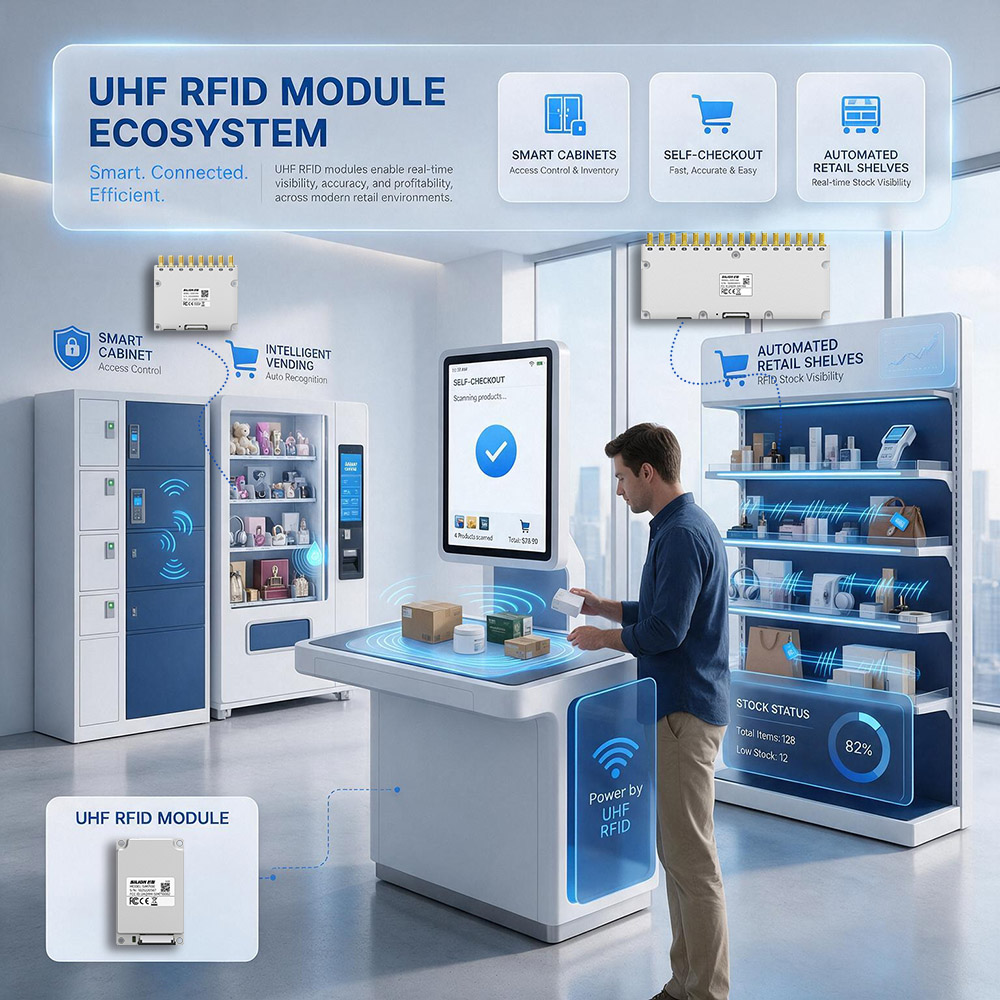
Retail stores are changing fast. Long checkout lines, staff shortages, and theft are pushing store owners to look for smarter tools. One of the biggest answers to these problems is UHF RFID technology. It lets a store "see" every product on a shelf or in a cart without anyone scanning a single barcode. In this guide, we explain what UHF RFID modules are, how they work inside self-checkout kiosks, smart cabinets, and automated stores, and what to look for when choosing one.
Why Retailers Are Choosing UHF RFID Over Barcodes
Barcodes need a person to scan each item one by one. RFID does not. A single UHF RFID module can read dozens or even hundreds of tags in seconds, without anyone lining products up. This is the core reason self-checkout, smart cabinets, and automated retail all rely on RFID instead of older barcode systems.
• Faster checkout: customers place items in a bin or cart, and every tag is read at once.
• Lower theft: the system knows instantly if an item leaves the store without being paid for.
• Better stock accuracy: staff can count entire shelves in seconds instead of hours.
• Less staff needed: stores can run 24/7 with little or no staff on site.
Key Use Cases of UHF RFID Modules in Retail
1. Self-Checkout Systems
In a self-checkout kiosk, a UHF RFID module is placed inside or under the checkout counter. When a customer places items in the scan area, the module reads every RFID tag at once and shows the full list of items and the total price on screen. There is no need to remove items from a bag or line up barcodes. This cuts checkout time from minutes to seconds and reduces the checkout staff a store needs.
2. Smart Cabinets and Vending
Smart cabinets are used for things like retail displays, medicine cabinets, tool cribs, and unmanned vending units. A UHF RFID module is fitted inside the cabinet, often near the door or shelf. When a customer opens the door and takes an item, the module notices the tag is missing and automatically records the sale or usage. This works well for high-value items, cosmetics, electronic accessories, and even hospital supply cabinets.
Note: Metal cabinet enclosures alter RF performance; antenna layout inside the cabinet requires careful tuning to reduce blind spots and signal reflections.
3. Automated and Unmanned Retail Stores
Fully automated stores, sometimes called "grab and go" stores, use several UHF RFID modules placed at the entrance, exit, and shelves. As a customer walks in, picks up items, and walks out, the modules track what left the store and charge the customer automatically through an app. This use case needs modules with well tunable RF power and Gen2X TagFocus selective inventory capability to avoid mistakenly reading tags from neighboring shelves.
What to Look for in a UHF RFID Module
Not every RFID module fits every use case. A self-checkout counter needs different settings than a tall smart cabinet or a store entrance gate. Here is a simple comparison to guide your choice:
Feature | Why It Matters | What to Check |
Read range | Longer range means fewer missed reads at checkout or cabinet doors | Test at your real distance, not the datasheet max |
Chip type | The chip decides sensitivity, speed, and tag capacity | Impinj E-series chips (E310/E510/E710/E910) are common industry choices |
Number of antenna ports | More ports let one module cover more shelves or gates | Match ports to your cabinet or gate layout |
Read speed (tags/second) | Fast reads keep checkout lines moving | Ask for real world speed with mixed tag types; Gen2X enabled modules deliver higher throughput under dense tag retail conditions. |
Interface | Decides how easy it is to connect to your POS or IoT system | USB, UART, RS232, or Ethernet, depending on your setup |
Size and mounting | Smart cabinets and kiosks have limited space | Compact modules fit inside shelves and small enclosures |
Power output (RF power) | Affects range and tag reliability | Adjustable RF power helps tune for dense tag environments and complies with regional FCC / ETSI radio limits; lower power settings are often required for controlled short range self checkout and smart cabinet deployments. |
How Silion Tech Supports These Use Cases
Silion Tech builds UHF RFID modules for exactly these kinds of retail projects. Our module lineup, including the SIM7100, SIM7200, SIM7300, SIM9100, SIM3800, and SIM3600 series, is built on trusted Impinj E310, E510, E710, and E910 chips. These chips are known across the RFID industry for stable performance, good read sensitivity, and reliable tag counting, which matters a lot in busy checkout lines or crowded smart cabinets.
As an Impinj Gold Partner, Silion Tech tests every module against real retail conditions, not just lab settings, so store owners and system integrators get a module that performs the same way on a live shop floor as it did in testing.
Frequently Asked Questions
What is the read range of a UHF RFID module?
Read range depends on the chip, antenna, and power setting, and can run from a few centimeters up to several meters. Self-checkout counters usually need a short, controlled range, while store entrance gates need a longer range.
Can UHF RFID modules read tags through packaging?
Yes. UHF RFID does not need a direct line of sight, so it can read tags through cardboard, plastic, and most fabrics. Signal performance degrades significantly with liquid filled packaging or metal laminated layers, so proper tag placement and tag selection are critical for those cases.
Is UHF RFID better than barcode scanning for retail?
For high-volume or self-service retail, yes. UHF RFID reads many items at once without manual scanning, which speeds up checkout and cuts labor needs. Barcodes are still useful for very low-cost, low-volume items where tagging cost is not worth it.
What is the difference between a UHF RFID reader and a UHF RFID module?
A reader is often a finished, ready-to-use device. A module is the core electronic board that manufacturers and system integrators build into their own kiosks, cabinets, or gates, which allows more control over size, design, and cost.
Which Impinj chip should I choose for a retail RFID project?
It depends on the project. Entry-level projects often use the E310 or E510 for a good balance of cost and performance, while larger or high-density retail setups may need the E710 or E910 for higher read speed and tag capacity. Silion Tech can help match the right chip to your specific setup.
Final Thoughts
UHF RFID modules are becoming the backbone of modern retail, from small self-checkout kiosks to fully automated stores. The right module choice depends on your read range needs, cabinet size, and how many tags you expect to read at once. Silion Tech's UHF RFID modules, built on trusted Impinj chips, are designed to meet these needs across self-checkout, smart cabinet, and automated retail projects.
Want to talk through which UHF RFID module fits your retail project? Contact the Silion Tech team for a free consultation.