Your location: Home Page > RFID Blog | SILION TECH > Impinj E310 vs E510 vs E710: Which UHF RFID Reader Chip Is Best for Your Application?
News and Information
Impinj E310 vs E510 vs E710: Which UHF RFID Reader Chip Is Best for Your Application?
Author:2026-11-05 18:00:00
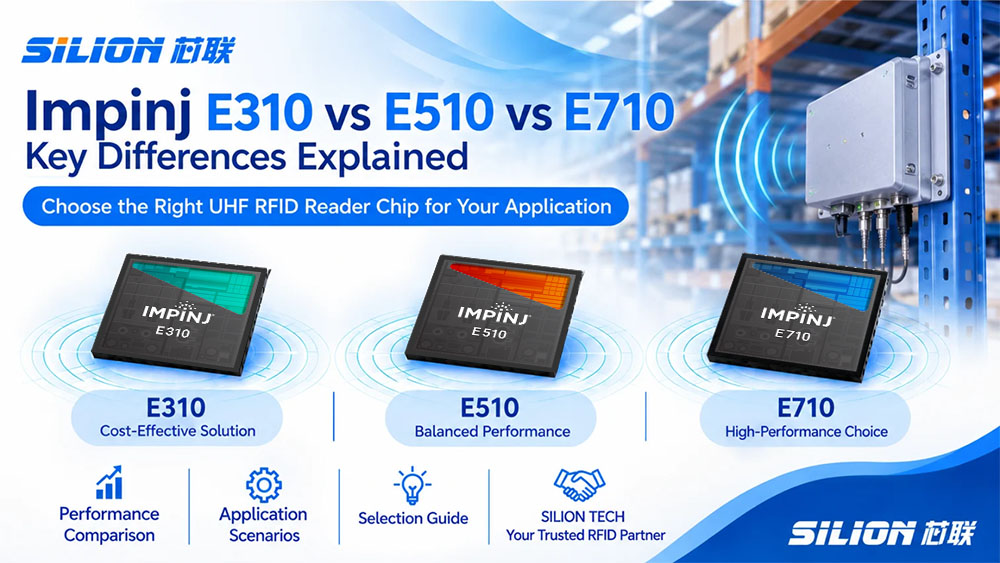
Choosing the right UHF RFID reader chip is one of the first decisions in developing an RFID reader, handheld device, fixed reader, or inventory management system. Impinj offers three RAIN RFID reader chips for this purpose: the E310, the E510, and the E710. Each is built for different performance, power, and cost requirements.
So what is the actual difference between the three, and which one should you choose for your project? This guide compares the chips, explains where each one fits, and helps OEM manufacturers and system integrators select the right SILION TECH UHF RFID module.
What Are the Impinj E310, E510 and E710 Reader Chips?
The E310, E510, and E710 are Impinj RAIN RFID reader integrated circuits (ICs), commonly called reader chips. They provide the core reading functions inside an RFID reader module, allowing a device to identify and communicate with UHF RFID tags without direct line of sight. They are used in retail inventory management, logistics, asset tracking, handheld readers, and industrial automation.
All three chips support RAIN RFID technology, but they serve different performance and cost targets. According to Impinj, the E710 is its highest-performance option, the E510 offers a mid-range balance, and the E310 is the cost-effective choice.
1. Impinj E310: Cost-Effective RFID Performance
The E310 suits products where compact size, low cost, and dependable tag identification matter more than maximum read performance. Impinj positions its E310 series for printers, kiosks, point-of-sale devices, and security and access management systems.
Key advantages
• Cost-effective reader chip.
• Compact, suitable for space-constrained devices.
• Supports embedded UHF RFID applications.
• A good fit for kiosks, printers, and similar equipment.
• Meets moderate tag-reading requirements.
Common applications
• RFID printers.
• Kiosks and point-of-sale devices.
• Access control systems.
• Compact handheld and desktop RFID readers.
• Embedded inventory management devices.
For cost-sensitive products, E310-based modules are a practical starting point because not every application needs a higher-performance chip.
2. Impinj E510: Balanced Performance and Efficiency
The E510 sits between the E310 and the E710 on price and performance. It is designed for applications that need stronger reading than the E310 while keeping power consumption and overall device cost under control. Impinj also highlights the E510 series for battery-powered devices, which makes it relevant to manufacturers of mobile and connected RFID equipment.
Key advantages
• Mid-range performance and cost.
• Designed for efficient integration into RFID devices.
• Suitable for mobile and battery-powered equipment.
• Supports a broad range of embedded RFID applications.
• A practical balance for moderate-to-demanding reading requirements.
Common applications
• Mobile RFID readers.
• Point-of-sale devices.
• Wearable RFID equipment.
• Smart appliances.
• Embedded RFID systems.
Consider the E510 when an E310-based design falls short on performance, but the application does not justify an E710-based design.
3. Impinj E710: High-Performance RFID Reading
The E710 is the high-performance option of the three. It is built for demanding applications that need reliable identification of large tag populations, strong sensitivity, and fast read rates. Impinj points to high-performance handheld readers, as well as fixed readers in smart shelves, cabinets and conveyors.
E710-based modules are particularly relevant to fixed RFID readers, warehouse inventory systems, multi-antenna installations and industrial applications.
Key advantages
• Highest performance positioning of the three chips.
• Designed for demanding RFID applications.
• Suitable for systems that handle large tag populations.
• Supports high-performance embedded reader designs.
• Available in modules with multiple antenna ports.
Common applications
• Warehouse inventory management.
• Retail inventory tracking.
• Fixed readers, portals and gates.
• Smart shelves and cabinets.
• Industrial asset tracking.
• Logistics and supply chain management.
For projects with large inventory volumes or several reading zones, E710-based modules deserve evaluation.
E310 vs E510 vs E710: Main Differences
The table below summarizes how the three chips are positioned.
Feature | E310 | E510 | E710 |
Performance category | Entry-level | Mid-range | High-performance |
Cost positioning | Lower | Medium | Higher |
Impinj target applications | Printers, kiosks, point-of-sale, security and access management | Point-of-sale, mobile and wearable readers, smart appliances | High-performance handheld and fixed readers, smart shelves, conveyors |
Typical devices | Compact embedded devices | Mobile and battery-powered devices | Fixed readers and multi-antenna systems |
Best suited for | Cost-sensitive projects | A balance of performance and efficiency | Advanced deployments with large tag populations |
Important: Actual read distance, read rate, RF output power, and antenna configuration depend on the complete RFID module, antenna, firmware, tag type, and operating environment. This comparison describes the general positioning of the chips, not guaranteed performance specifications for any module.
How to Choose the Right Impinj RFID Reader Chip
Base the choice on your application requirements instead of automatically selecting the most powerful chip. Ask these three questions.
1. What type of RFID device are you developing?
For compact, cost-sensitive equipment, consider the E310. For mobile or battery-powered equipment that needs a balance of performance and efficiency, evaluate the E510. For demanding fixed-reader and multi-antenna applications, the E710 is the one to consider.
2. How many RFID tags do you need to read?
If your application involves moderate tag populations, an E310 or E510-based module may be enough. For large inventories and demanding reading environments, an E710-based solution offers greater performance capability.
3. How many antenna ports does your project require?
The number of antenna ports is set by the module design, not by the chip name. Modules may offer a single port, four ports, eight ports, or sixteen ports, so confirm the port count of the specific module you plan to use.
Before you select a module, also evaluate the host interface, RF output power, module dimensions, thermal requirements, software development support, and the regulatory frequency requirements of your target market.
Why Choose SILION TECH for Impinj-Based UHF RFID Modules?
The reader chip is only one part of a successful RFID product. The module's hardware design, antenna connectivity, RF performance, software support, and integration options matter just as much.
SILION TECH is an Impinj Global Gold Partner. SILION TECH provides UHF RFID reader modules based on all three Impinj reader chips: the E310, E510, and E710. Its portfolio covers different module series, versions, form factors, and antenna-port configurations to meet OEM and industrial requirements, from compact embedded modules to mobile reader modules and multi-port solutions for fixed RFID systems. For example, its E710-based SIM7100, SIM7200, SIM7300 and SIM7400 modules offer one, four, eight and sixteen antenna ports respectively.
Whether you are developing a handheld reader, a retail inventory solution, a warehouse tracking system, or an industrial RFID device, SILION TECH offers E310, E510, and E710-based options to match your project.
Explore SILION TECH's complete range of UHF RFID modules or contact its technical sales team to discuss the right module for your application.
• Website: https://en.silion.com.cn/
• Email: sales@silion.com.cn
• WhatsApp / WeChat: +86-137-2421-6730
Frequently Asked Questions (FAQs)
Q1. What is the main difference between Impinj E310, E510 and E710?
The E310 is positioned as the cost-effective reader chip, the E510 offers a mid-range balance of price and performance, and the E710 is designed for higher-performance RFID applications.
Q2. Which Impinj chip is best for a handheld RFID reader?
It depends on the device requirements. The E310 and E510 suit compact, cost-sensitive or battery-powered designs, while the E710 is an option for handheld readers that need higher performance.
Q3. Which Impinj chip is recommended for high-performance multi-antenna RFID systems?
The number of supported antenna ports depends on the module design rather than the chip. E710-based modules are well suited to demanding multi-antenna systems and are available with up to sixteen ports, but you should check the port count of each specific module.
Q4. Does SILION TECH offer modules based on all three Impinj chips?
Yes. SILION TECH offers UHF RFID module series based on the E310, E510 and E710, with different versions, designs and antenna-port configurations. Click here for details
Important: Actual read distance, read rate, RF output power, and antenna configuration depend on the complete RFID module, antenna, firmware, tag type, and operating environment. This comparison describes the general positioning of the chips, not guaranteed performance specifications for any module.