Your location: Home Page > RFID Blog | SILION TECH > How RAIN RFID Is Transforming Automotive Manufacturing: From Assembly Lines to Smart Factories
News and Information
How RAIN RFID Is Transforming Automotive Manufacturing: From Assembly Lines to Smart Factories
Author:2026-11-14 15:00:00
Automotive factories manage thousands of parts, tools, containers, and vehicles. A missing component can delay production, while an incorrect part can create quality problems. Barcodes help, but each label usually needs to be visible to a scanner. RAIN RFID identifies tagged items wirelessly, often without direct line of sight. It connects production activity with digital records and helps teams make decisions.
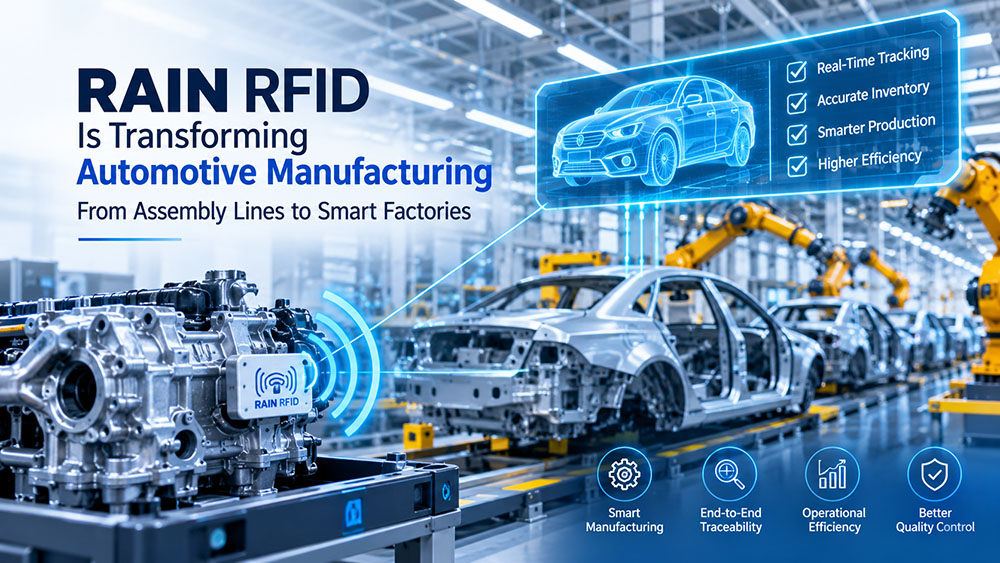
What Is RAIN RFID in Automotive Manufacturing?
RAIN RFID is passive ultra high frequency (UHF) radio frequency identification built upon the GS1 EPC Gen2 air interface protocol, which is standardized internationally under ISO/IEC 18000 63. A system uses a tag, a reader, and software. The tag has no battery; it receives energy from the reader’s radio signal and returns its identity. Depending on the tag, reader, antenna, and environment, multiple tagged items can often be identified quickly.
Where RAIN RFID Makes a Difference on the Factory Floor
1. Tracking parts and work in progress
Vehicles pass through body assembly, painting, final assembly, and inspection. Tags on carriers, skids, or suitable components can identify items at each stage. Fixed readers record when an item passes, update its production status, and reduce repeated manual scans.
2. Improving inventory and material flow
Production depends on a steady supply of fasteners, electronics, wiring harnesses, seats, and many other components. RAIN RFID can support receiving, warehouse storage, line-side replenishment, and shipment checks. Readers at dock doors or storage zones can capture tagged cases and containers, helping teams find missing or mis-routed materials before they affect the production line.
3. Supporting quality control and traceability
A vehicle contains thousands of components from different suppliers. Linking component IDs to batch, supplier, and assembly records can help teams investigate quality issues. RFID events can show where a tagged part was received, stored, or installed, if those events are captured accurately.
This history can help identify vehicles or batches that need checking. RFID does not replace inspection, testing or formal quality procedures. It adds item identification and process data that can make traceability easier.
4. Managing tools, equipment and tires
Tags on shared tools and test equipment can help teams check availability and reduce losses. RAIN RFID is also used for tire identification. Purpose built tire tags can retain a unique identity through manufacturing, distribution, vehicle operation, and subsequent service or retreading (subject to proper tag design and installation).
Tire applications need tags and installation methods tested for their operating conditions; ordinary labels are not suitable for every harsh process.
From Connected Assembly Lines to Smart Factories
RFID data becomes more valuable when connected with factory software, sensors, automated guided vehicles, and production equipment. A read event can confirm a component’s arrival, update a vehicle’s status, request replenishment, or record a container’s return. Combined data can reveal recurring delays and support planning across shifts or sites.
A reader alone does not create a smart factory. The system needs reliable network connections, integration with existing software, and clear rules for exceptions. Staff must know what to do when a tag is missed, read twice, or linked to an unexpected item.
Important Technical Considerations Before Deployment
Automotive environments challenge radio communication. Metal can reflect or block signals; liquids, dense stacks, moving vehicles, and nearby readers can affect performance. Test tags and antenna positions on the actual item and at the intended read point. A label that works on cardboard may perform poorly on a metal part.
Define the problem and required read zone first. Decide which items need tags, what event to capture, how quickly data is needed, and which system will use it. Test tag type, reader power, antenna position, speed, orientation, and interference on site. Plan read zones to avoid unrelated reads, and include security, access permissions, and maintenance.
Choosing the Right RFID Hardware and Integration Partner
Fixed readers, embedded UHF RFID modules, antennas and development boards suit different equipment designs. Selection depends on read range, antenna ports, tag volume, speed, host interface, operating environment, and software requirements. An embedded module can add UHF RFID capability to a custom device.
SILION TECH supplies UHF RFID modules, readers, and development boards for complete smart-manufacturing solutions. When selecting hardware for your integration project, review our UHF RFID portfolio and confirm specifications and compatibility with your target tags and software.
RAIN RFID can improve visibility across parts, work in progress, reusable assets, and finished vehicles. Its value comes from connecting item identification with production decisions, not tagging everything without a plan. Start with a pilot at one receiving point, assembly station, or container loop. Measure read accuracy, time saved, and stock discrepancies before expanding. Suitable tags, tested reader placement, and sound integration make RFID a useful building block for a connected factory across the wider operation.
Frequently Asked Questions
Does RAIN RFID need a battery?
No. Passive RAIN RFID tags receive energy from the reader’s radio signal and do not need a battery.
Can RAIN RFID read metal automotive parts?
Yes, but use tags designed for metal mounting. General-purpose labels may not perform reliably on metal surfaces.