Your location: Home Page > RFID Blog | SILION TECH > The Evolution of RFID Technology - From Early Radio Experiments to Intelligent Identification Systems
News and Information
The Evolution of RFID Technology - From Early Radio Experiments to Intelligent Identification Systems
Author:2026-11-23 15:00:00
From Early Radio Experiments to Intelligent Identification Systems
Introduction
Radio Frequency Identification (RFID) has transformed the way businesses identify, track, and manage products, equipment, and assets. What started as an early radio-based identification concept has developed into a widely used technology across retail, healthcare, manufacturing, logistics, transportation, and supply chain management.
The evolution of RFID technology did not happen overnight. It took decades of research, improvements in radio communication, semiconductor development, and international standardization to make modern RFID systems practical and commercially accessible. Today, RFID allows organizations to identify multiple tagged items without requiring direct physical contact or line-of-sight scanning.
Understanding this evolution helps explain why RFID has become an important part of modern industrial automation and digital identification.
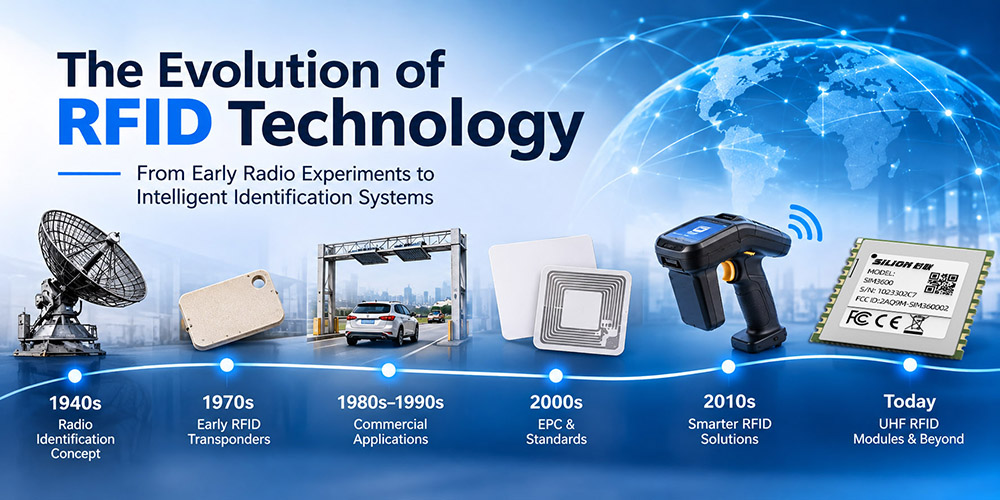
1. The Beginning of RFID: 1940s and World War II
The origins of RFID are closely connected to radar technology developed during World War II. Military forces needed a reliable way to distinguish friendly aircraft from enemy aircraft. This led to the development of Identification Friend or Foe (IFF) systems.
These systems used radio signals to identify aircraft. A transponder installed on an aircraft received a signal from a radar station and transmitted a response identifying it as friendly.
Although IFF was not the same as today's commercial RFID, it introduced an important principle: using radio waves to identify objects remotely.
In 1948, Harry Stockman published his research paper, Communication by Means of Reflected Power. His work became one of the important theoretical foundations for modern RFID development.
2. Research and Early Commercial Applications: 1950s–1970s
During the 1950s and 1960s, researchers continued exploring radio-frequency communication and passive identification systems. However, limitations in electronic components, manufacturing costs, and available technology prevented widespread commercial adoption.
A major milestone came in 1973 when Mario Cardullo received a US patent for a passive RFID transponder with rewritable memory. Around the same period, Charles Walton received a patent for a passive transponder used in electronic door-lock systems.
Government research also contributed to RFID development. Los Alamos National Laboratory explored RFID applications for tracking nuclear materials and livestock.
These projects demonstrated that RFID could support practical identification and tracking tasks beyond military applications.
3. Commercial Expansion and UHF Development: 1980s–1990s
During the 1980s, RFID moved into practical commercial applications. Electronic toll collection, vehicle identification, animal tracking, and access control became important areas of adoption.
The 1990s brought important progress for Ultra-High Frequency (UHF) RFID. IBM engineers advanced UHF-based RFID concepts for supply-chain use-cases, delivering longer reading distances and faster data communication under suitable operating conditions.
However, high hardware costs and the absence of widely accepted international standards limited its early adoption.
In 1999, the MIT Auto-ID Center was established to develop affordable identification systems for supply chains. Its research helped introduce the Electronic Product Code (EPC), supporting the identification of individual products through RFID tags.
4. Standardization and the Growth of RAIN RFID: 2000s–2010s
Standardization played a major role in making RFID more accessible to businesses worldwide. In 2004, the EPC Class 1 Generation 2 (Gen2) protocol was published, providing a common communication framework for passive UHF RFID readers and tags. It was subsequently incorporated into ISO/IEC 18000-63.
This development improved interoperability between compatible RFID equipment from different manufacturers.
In 2014, the RAIN Alliance was established to promote passive UHF RFID technology. RAIN RFID became an important part of inventory management, retail operations, logistics, manufacturing, and asset tracking.
5. Modern RFID Technology and Its Applications
Modern RFID systems combine tags, antennas, readers, and software to collect identification data automatically. Passive UHF RFID, commonly known as RAIN RFID, is particularly useful when businesses need to identify multiple items quickly without scanning each label individually.
Today's applications include warehouse inventory management, industrial production tracking, healthcare equipment identification, retail stock management, and supply chain visibility.
Modern UHF RFID modules also provide flexible integration options for manufacturers developing fixed readers, handheld terminals, smart devices, and automated identification equipment.
6. What Is Next for RFID Technology?
RFID continues to develop through improvements in reader performance, tag design, connectivity, and data processing. Integration with cloud platforms, the Internet of Things (IoT), and artificial intelligence can help businesses turn RFID-generated information into more useful operational insights.
However, successful real‑world implementation still depends on selecting suitable frequencies, antennas, reader modules, tag types, and configurations matched to your operating environment.
The evolution of RFID technology represents decades of engineering progress, from early military identification systems to modern wireless identification solutions. As industries demand better visibility, faster inventory processes, and more accurate asset tracking, RFID will continue to play an important role in digital transformation.
For businesses developing RFID-enabled products and systems, choosing reliable hardware is an essential step. SILION TECH provides UHF RFID modules and solutions designed for integration into different RFID applications.
Explore SILION TECH’s UHF RFID modules: https://en.silion.com.cn/rfidmodule.html
Contact: sales@silion.com.cn | WhatsApp: +86-137-2421-6730
Research Sources
· RFID Journal – The History of RFID Technology: https://www.rfidjournal.com/expert-views/the-history-of-rfid-technology/76202
· Cambridge University Press – Radio Frequency Identification Engineering: https://assets.cambridge.org/97811084/89713/excerpt/9781108489713_excerpt.pdf
· GS1 – EPC Gen2 UHF RFID Standard: https://ref.gs1.org/standards/gen2/
· RAIN Alliance – What Is RAIN Technology?: https://therainalliance.org/what-is-rain/
· SILION TECH – UHF RFID Modules: https://en.silion.com.cn/rfidmodule/