Your location: Home Page > RFID Blog | SILION TECH > Switching from Barcode to RFID: A Smarter Upgrade for Modern Businesses
News and Information
Switching from Barcode to RFID: A Smarter Upgrade for Modern Businesses
Author:2026-03-20 09:00:00
Why Businesses Are Moving from Barcodes to RFID Technology
In today’s fast-paced and highly competitive business environment, companies are constantly looking for ways to improve efficiency, reduce costs, and gain better control over their operations. For many years, barcode technology has played a crucial role in inventory tracking and asset management. It has been simple, affordable, and widely adopted across industries. However, as business demands continue to grow, especially in terms of speed, automation, and data accuracy, barcode systems are increasingly showing their limitations. This is where RFID technology emerges as a more advanced and scalable solution.
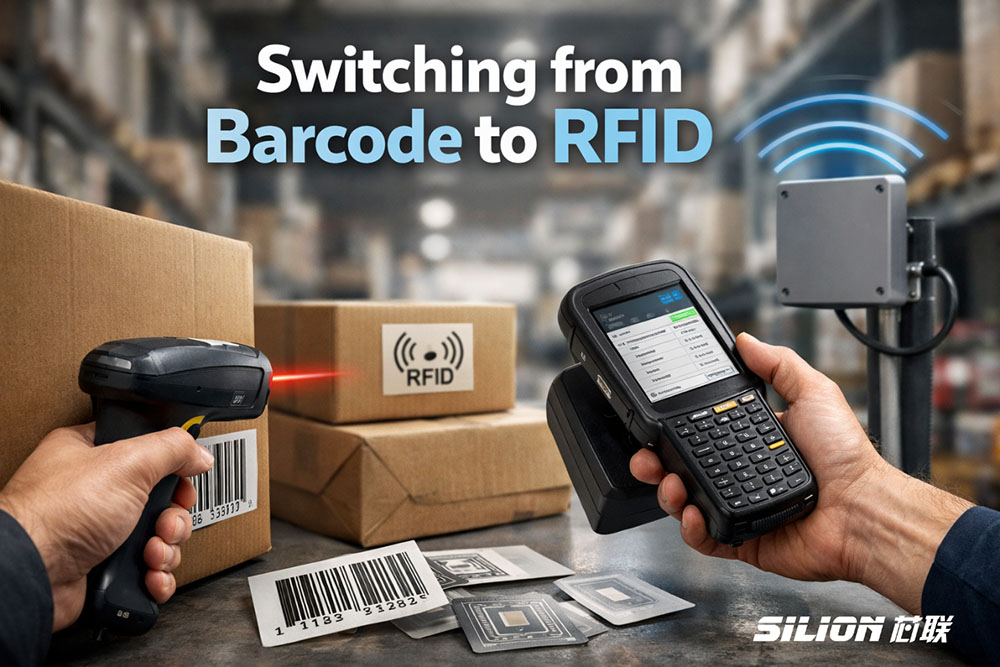
At its core, both barcode and RFID technologies serve a similar purpose: identifying and tracking items. However, the way they operate is fundamentally different. Barcodes rely on optical scanning, meaning each label must be individually visible to a scanner. RFID, on the other hand, uses radio waves to communicate between tags and readers, enabling a much more efficient and flexible tracking system. This key difference is driving businesses across industries such as retail, logistics, healthcare, and manufacturing to shift toward RFID.
Key Advantages of RFID Over Barcodes
1. Faster Data Capture and Bulk Scanning
One of the most significant advantages of RFID over barcodes is speed. Traditional barcode systems require manual, one-by-one scanning of items. This process can be time-consuming, especially in warehouses or retail environments where thousands of products need to be processed daily. RFID eliminates this bottleneck by allowing multiple tags to be read simultaneously.
Hundreds of items can be scanned in a matter of seconds without needing to unpack or even directly handle them. This dramatically accelerates processes such as inventory audits, receiving shipments, and order fulfillment. As a result, businesses can save valuable time, reduce labor costs, and significantly improve overall productivity.
2. No Line-of-Sight Requirement
Another major limitation of barcodes is their dependency on line-of-sight scanning. A barcode must be clearly visible and properly aligned with the scanner to be read successfully. Even minor issues such as dirt, scratches, or poor printing can cause scanning failures.
RFID technology removes this constraint entirely. Since it uses radio waves, RFID tags can be read without direct visibility. They can be embedded inside packaging, placed within boxes, or positioned in any orientation, and still be detected accurately. This flexibility not only simplifies operations but also allows for more innovative and efficient packaging and storage solutions.
3. Enhanced Security and Anti-Counterfeiting
Security is another area where RFID offers clear advantages. Barcodes are essentially printed images, which makes them easy to copy or duplicate. This creates vulnerabilities in industries where product authenticity and supply chain security are critical.
RFID tags, however, store data electronically and can include unique identifiers and encryption features. This makes them much harder to replicate or tamper with. Businesses can use RFID Modules to verify product authenticity in real time, helping to prevent counterfeiting and protect brand reputation. This is particularly valuable in sectors such as pharmaceuticals, luxury goods, and electronics.
4. Greater Durability and Reliability
Durability and reliability are also key factors driving the adoption of RFID. Barcode labels are prone to damage from environmental factors such as moisture, heat, dirt, and physical wear. Once a barcode is damaged, it often becomes unreadable, leading to delays and errors.
RFID tags are designed to be more robust. The chip and antenna are typically embedded within the label or product, providing protection against harsh conditions. This makes RFID a more reliable solution for industries like manufacturing, warehousing, and outdoor logistics, where items are frequently exposed to challenging environments.
5. Real-Time Automation and Visibility
One of the most transformative benefits of RFID is its ability to enable real-time automation and visibility. Unlike barcodes, which require manual scanning, RFID systems can operate automatically. Fixed RFID readers can be installed at key points such as warehouse entrances, conveyor belts, or store exits.
These readers continuously monitor and record the movement of tagged items without human intervention. This provides businesses with real-time insights into inventory levels, asset locations, and supply chain activities. With access to accurate and up-to-date data, companies can make faster and more informed decisions, respond quickly to issues, and optimize their operations more effectively.
6. Improved Accuracy and Reduced Human Error
In addition to automation, RFID significantly improves accuracy by reducing human error. Manual barcode scanning is susceptible to mistakes, especially in high-pressure environments where speed is essential. Items can be missed, scanned incorrectly, or recorded inaccurately.
RFID minimizes these risks by automating data capture and ensuring consistent, reliable readings. This leads to more accurate inventory records, fewer discrepancies, and better overall control of business processes. Improved accuracy also enhances customer satisfaction by reducing errors in order fulfillment and ensuring product availability.
Is It Time to Upgrade to RFID?
Despite these advantages, it is important to note that barcode systems are not entirely obsolete. They still serve as a cost-effective solution for simple applications and smaller businesses with limited operational complexity. However, for organizations that require high efficiency, scalability, and real-time visibility, RFID presents a clear upgrade.
The transition from barcode to RFID technology represents a significant step forward for modern businesses. RFID offers faster data capture, eliminates line-of-sight limitations, enhances security, improves durability, and enables real-time automation. As industries continue to evolve and demand greater efficiency and transparency, RFID solutions are becoming the preferred choice for enterprises pursuing operational efficiency and digital transformation.