Your location: Home Page > RFID Blog | SILION TECH > UPS Expands RFID Deployment to Boost Visibility and Productivity in Logistics Network
News and Information
UPS Expands RFID Deployment to Boost Visibility and Productivity in Logistics Network
Author:Supply Chain Dive2026-04-09 14:00:00
Global logistics leader UPS is accelerating the adoption of RFID (Radio Frequency Identification) technology across its operations, aiming to improve package visibility, reduce manual work, and increase overall efficiency.
According to recent statements from CEO Carol Tomé, the company has now introduced RFID labelling at all The UPS Store locations, which number more than 5,500 across the United States. This rollout marks a major step in UPS’s long-term plan to build a smarter and more automated logistics network.
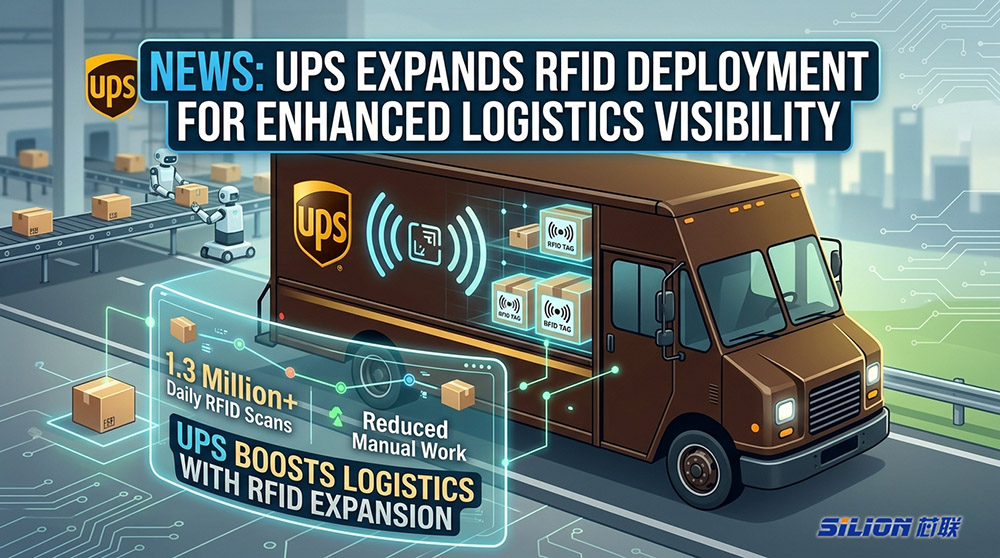
With this expansion, UPS is currently processing around 1.3 million packages every day using RFID labels. These RFID labels enable automatic package detection and tracking throughout the delivery process, supported by onboard readers in UPS delivery vehicles, giving both UPS and its customers better visibility throughout the delivery process.
Tomé explained that RFID technology improves transparency across the entire “order-to-cash” cycle, from order placement to final delivery and payment reconciliation. This means businesses can track shipments more accurately from the time an order is placed until the product is delivered and paid for. In today’s fast-moving e-commerce environment, this level of visibility has become increasingly important for both retailers and logistics providers.
In addition to deploying RFID labels at retail locations, UPS has also equipped its delivery vehicles with RFID readers. These readers can automatically detect and identify packages inside the vehicle without requiring drivers to manually scan each item. This innovation significantly reduces the need for handheld scanning devices and speeds up delivery operations.
UPS reported that the use of RFID technology has already eliminated millions of manual scans per day. In 2024 alone, the company reduced approximately 12 million daily scans by implementing RFID systems in a large portion of its fleet. Previously, about 66% of UPS package cars were equipped with this technology, and the company continues to expand this coverage.
The RFID initiative is part of UPS’s broader “Smart Package, Smart Facility” strategy. This strategy focuses on combining automation, data, and advanced tracking technologies to improve operational performance. By reducing manual processes and increasing automation, UPS aims to handle higher package volumes while maintaining accuracy and speed.
Automation is a key priority for UPS as it adjusts its network to changing market conditions. The company is currently transitioning toward what it describes as a “smaller and more flexible” operating model. This shift comes as shipping volumes from major customers fluctuate and as the demand for faster delivery continues to grow.
UPS has already made significant progress in automating its facilities. The company reported that a large portion of its U.S. package volume is now processed through automated buildings. These facilities use advanced systems to sort and move packages with minimal human intervention.
The financial benefits of automation are also clear. According to UPS, the cost of processing a package in an automated facility is approximately 28% lower than in a traditional, manually operated building. This cost advantage allows the company to improve profitability while maintaining competitive pricing.
UPS plans to continue expanding its automation efforts in the coming years. The company has already automated over 100 facilities and intends to add more in the near future. This ongoing investment reflects the company’s commitment to building a modern and efficient logistics network.
Beyond operational improvements, RFID technology is also helping UPS strengthen its relationships with customers. Large retailers and e-commerce companies increasingly demand real-time tracking and better control over their supply chains. RFID provides detailed information about incoming shipments, enabling businesses to plan their warehouse operations more effectively.
For example, retailers can use RFID data to know exactly when shipments will arrive and what they contain. This allows them to allocate staff more efficiently and reduce delays in processing incoming goods. As a result, companies can improve both speed and customer satisfaction.
UPS is also enhancing its digital capabilities to support business customers. The company’s digital platforms integrate with popular e-commerce services such as eBay and Shopify, allowing sellers to access shipping tools, pricing options, and logistics services more easily.
These digital services have seen rapid growth in recent years, driven by the global expansion of online shopping. By combining digital tools with advanced tracking technologies like RFID, UPS aims to offer a complete solution for modern logistics needs.
Industry analysts believe that UPS’s investment in RFID reflects a broader trend across the logistics sector. As supply chains become more complex and customer expectations continue to rise, companies are turning to technologies that provide greater visibility, accuracy, and efficiency.
RFID, in particular, is gaining popularity because it allows for automatic identification and tracking without direct line-of-sight scanning. This makes it ideal for high-volume environments such as warehouses, distribution centers, and transportation networks.
SILION TECH’s Perspective
As a provider of UHF RFID modules and solutions, Silion Tech sees strong alignment with these industry developments. The growing adoption of RFID by global leaders like UPS highlights the increasing importance of smart tracking technologies in logistics and supply chain management.
Silion Tech offers a comprehensive portfolio of UHF RFID modules and components engineered to support high-performance tracking and automation systems for logistics applications. These solutions can be used in applications such as package identification, warehouse management, inventory tracking, and transportation monitoring.
For businesses looking to improve efficiency and reduce operational costs, adopting RFID solutions can be a practical and scalable solution. Even small and medium-sized companies can benefit from better visibility, reduced manual work, and faster processing times.
As the logistics industry continues to evolve, technologies like RFID are expected to play a central role in shaping the future of supply chains. Companies that invest in these solutions today will be better positioned to compete in an increasingly data-driven and fast-paced market.
UPS’s latest move serves as a clear example of how innovation and technology can drive efficiency, improve customer experience, and create new opportunities for growth across the logistics sector.
Source: Supply Chain Dive
Author: Max Garland
Next Article:Module Self-Heating and Its Effect on Frequency Accuracy