Your location: Home Page > RFID Blog | SILION TECH > UHF RFID vs NFC - Differences, Technical Boundaries & Application Scenarios
News and Information
UHF RFID vs NFC - Differences, Technical Boundaries & Application Scenarios
Author:2026-05-28 16:00:00
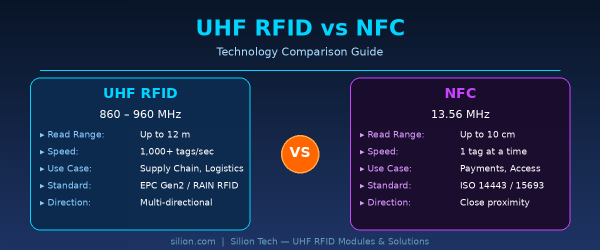
1. Introduction
Radio Frequency Identification (RFID) is a wireless technology that uses radio waves to automatically identify and track objects, people, or animals. If you have ever tapped a credit card to pay, scanned an employee badge at a door, or watched packages speed through an Amazon fulfillment center, you have already encountered RFID in one form or another.
But not all RFID is the same. The term RFID is an umbrella covering multiple frequency bands and protocols, each designed for different tasks. The two most widely deployed and commonly confused members of this family are UHF RFID (Ultra-High Frequency RFID) and NFC (Near Field Communication). Understanding the differences between them — and knowing when to deploy each — is the single most important decision in any wireless identification project.
This guide is your definitive reference. Whether you are a supply-chain manager sourcing RFID solutions, an engineer evaluating UHF RFID modules, a startup founder exploring RAIN RFID for your product, or simply someone curious about the technology inside a contactless card, this guide explains everything in clear, jargon-light language with concrete examples.
Quick Take — Two Technologies, One Family UHF RFID excels at long-range, high-volume identification (think scanning 500 cartons in seconds). NFC is optimised for secure, short-range, tap-and-go interactions (think paying at a coffee shop). They solve different problems and are often deployed side by side. |
2. What Is RFID? A Primer for Beginners
RFID is a system composed of three core components: a tag (also called a transponder), a reader (also called an interrogator), and backend software. The tag contains a microchip and an antenna. When a reader emits radio waves, the tag either reflects the waves (passive tag) or transmits a signal using its own battery (active or semi-passive tag). The reader captures that signal, decodes the data, and passes it to the software.
2.1 RFID Frequency Bands
RFID operates across several frequency ranges, and physics determines the characteristics of each:
• Low Frequency (LF) — 125–134 kHz: Short range (a few centimetres), penetrates metal and liquids well. Used in animal microchips and access proximity cards.
• High Frequency (HF) — 13.56 MHz: Range of 1–10 cm. The foundation of NFC. Used in contactless payments, library books, and passports.
• Ultra-High Frequency (UHF) — 860–960 MHz: Range of 1–12+ metres. The engine behind modern supply-chain RFID. Includes RAIN RFID.
• Microwave — 2.45 GHz and 5.8 GHz: Very long range, used in toll collection and vehicle tracking.
For this guide, we focus on the two that matter most for commercial deployments: UHF RFID and NFC.
3. What Is UHF RFID? Deep Dive
Ultra-High Frequency RFID operates between 860 MHz and 960 MHz (the exact band varies by region — 902–928 MHz in North America, 865–868 MHz in Europe, 920–925 MHz in China). Its defining characteristic is range: a passive UHF tag can be read from up to 12 metres with a fixed reader, and modern portal systems can scan hundreds of tagged items simultaneously using the Gen2 anti-collision protocol.
3.1 The EPC Gen2 Standard and RAIN RFID
The EPC Gen2 standard (more formally ISO/IEC 18000-63) is the global protocol that governs how UHF RFID tags and readers communicate. It was developed by GS1 and adopted by the EPCglobal organisation. In 2014, the industry marketing alliance RAIN RFID was formed to promote and brand this UHF RFID ecosystem — the name is derived from Radio frequency Identification (RFID) and Ambient Intelligence Networking (AIN).
What Does RAIN RFID Mean? RAIN RFID is the brand name for the global UHF RFID ecosystem based on the EPC Gen2 V2/ ISO/IEC 18000-63:2022 standard. When a product is 'RAIN RFID certified', it means the hardware and software interoperates with all other RAIN-certified devices worldwide. Think of it as the Wi-Fi Alliance certification for UHF RFID. |
3.2 How a UHF RFID System Works
Understanding the signal chain is essential for selecting the right components:
1. Reader/Antenna transmits RF energy: The reader generates a continuous wave or modulated signal at 860–960 MHz and transmits it through an antenna. The antenna shape (linear, circular, patch, near-far field) determines the read zone geometry.
2. Tag harvests energy: A passive UHF tag has no battery. It harvests power from the incoming RF signal through its antenna and uses it to power the microchip for a fraction of a second.
3. Backscatter communication: The tag modulates its antenna impedance, which changes the reflected signal back to the reader — a technique called backscatter. The reader decodes the changes to extract the EPC (Electronic Product Code) and other memory bank data.
4. Anti-collision singulation: The EPC Gen2 protocol uses the Dynamic Framed Slotted ALOHA (DFSA) / Q-algorithm anti-collision mechanism to support high-speed simultaneous tag reading. A dense reader mode allows hundreds of tags to be read per second without collision.
5. UHF RFID module processes data: In embedded or OEM deployments, a UHF RFID module (a compact system-in-package integrating the RF front end, baseband processor, and firmware) handles the entire protocol stack and delivers structured data via UART, USB, SPI, or TCP/IP to the host system.
3.3 What Is a UHF RFID Module?
A UHF RFID module is the heart of any embedded reader system. It is a miniaturised, self-contained unit — typically ranging from a credit-card size to a full-reader board — that packages the RF transceiver, digital signal processor, power management, and firmware into a single device. System integrators and OEMs use UHF RFID modules to build custom readers, handheld scanners, portal gates, conveyor-belt readers, and IoT gateways without having to design the RF hardware from scratch.
Key characteristics to evaluate when selecting UHF RFID modules include:
• RF output power: Typically 20 – 33 dBm(100mW - 2W). Higher power extends read range but may require regulatory compliance (e.g., FCC Part 15, ETSI EN 302 208).
• Sensitivity: Expressed in dBm. Higher sensitivity (more negative value) means the module can detect weaker tag responses, improving read reliability.
• Protocol support: EPC Gen2 (UHF), ISO 18000-63, multi-protocol modules may support additional frequencies.
• Interface options: UART, USB, SPI, RS-232, Ethernet, Wi-Fi, Bluetooth — determines integration flexibility.
• Form factor & power consumption: Critical for battery-powered handheld or IoT edge deployments.
• Read rate: Number of unique EPC codes the module can decode per second. Ranges from 50 to 1,500+ reads/second.
• Operating temperature: Industrial-grade modules (−40°C to +85°C) for harsh environments.
4. What Is NFC? Deep Dive
Near Field Communication (NFC) is a short-range wireless technology operating at 13.56 MHz, derived from the HF RFID family. It was standardised by the NFC Forum (founded in 2004 by Nokia, Philips, and Sony) and builds on ISO 14443 and ISO 15693 standards. The defining feature of NFC is its deliberately short range — typically 4 cm or less — which makes it inherently secure for proximity-based interactions.
4.1 NFC Operating Modes
NFC devices can operate in three modes, which is one reason for their versatility in consumer electronics:
• Reader/Writer Mode: An NFC-enabled device (like a smartphone) reads data from a passive NFC tag. Used for smart posters, product authentication, and URL launching.
• Peer-to-Peer (P2P) Mode: Two active NFC devices exchange data bidirectionally. Used in Android Beam (now deprecated) and newer contact-sharing applications.
• Card Emulation Mode: The NFC device mimics a contactless smart card, enabling mobile payments (Apple Pay, Google Pay) and access control through a phone.
4.2 NFC Tag Types
The NFC Forum defines five tag types (Type 1 through Type 5), each based on different ISO standards and with different memory sizes and capabilities. The most widely deployed are NXP's NTAG series (Type 2, up to 888 bytes) for consumer applications and NXP's MIFARE family (ISO 14443) for payment and access control.
NFC Security Advantage NFC's typical <4 cm operating range (ISO 14443) is not a limitation — it is a security feature. Under this standard, an attacker cannot silently skim an NFC card from across the room. Combined with cryptographic authentication (AES-128 in MIFARE DESFire, for example), NFC delivers strong security for payment, access, and identity applications. Note: HF RFID (ISO 15693, 13.56 MHz) can achieve read ranges up to 10–150 cm with large antennas, but this is not standard NFC for mobile or secure use cases. |
5. UHF RFID vs NFC: Detailed Technical Comparison
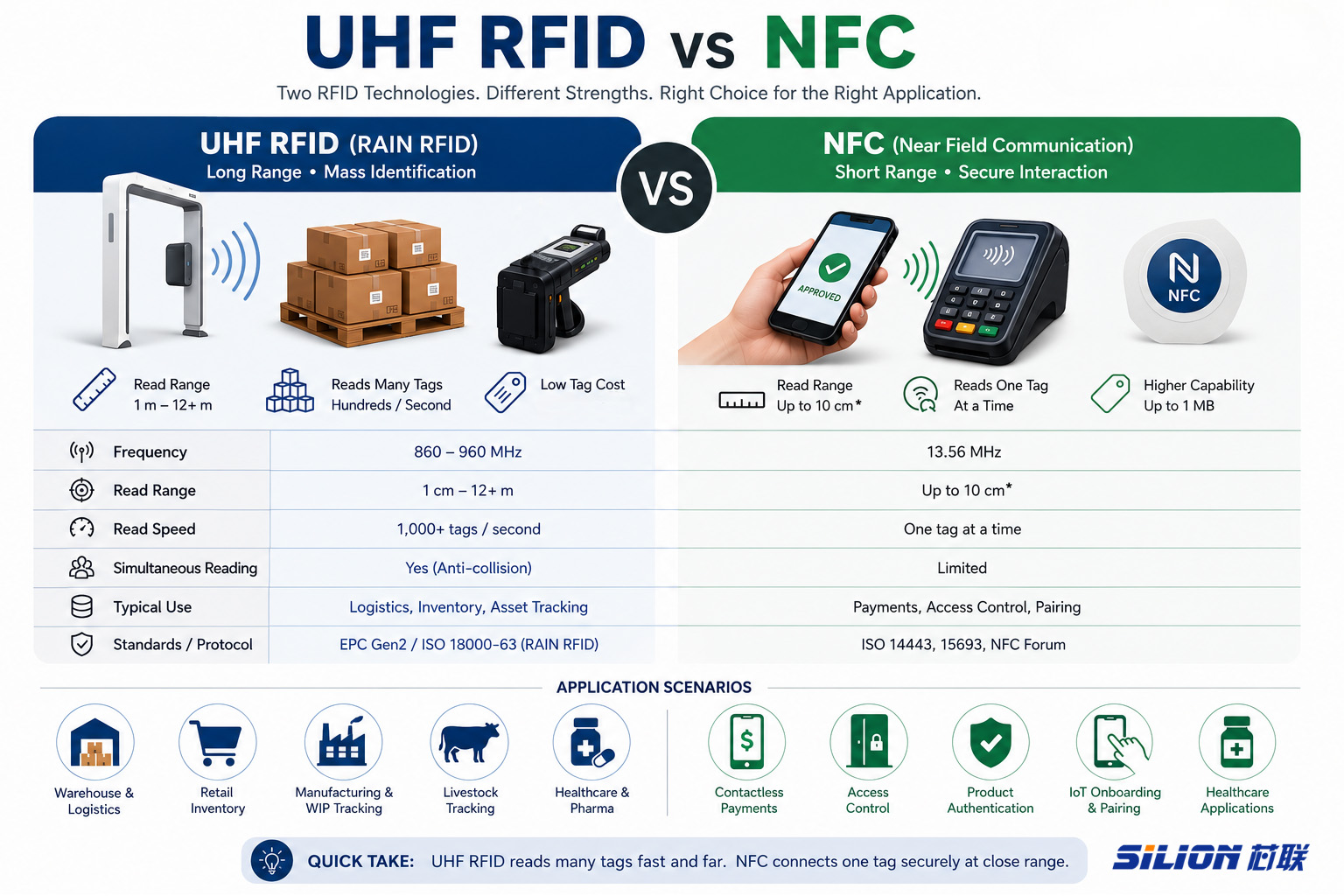
The table below provides a comprehensive side-by-side comparison of every significant technical and operational parameter. Use this as your reference checklist when making a technology selection decision for RFID solutions.
Feature / Parameter | UHF RFID (RAIN RFID) | NFC |
Frequency | 860–960 MHz | 13.56 MHz |
Read Range | 1 cm – 12 m+ | < 4 cm (ISO 14443); up to 150 cm (ISO 15693, large antenna) |
Read Speed | 1,000+ tags/second | One tag at a time |
Simultaneous Reading | Yes (Anti-collision) | Limited |
Data Capacity | 96–512 bits (EPC) | Up to 1 MB (NFC Type 5) |
Tag Cost | $0.05 – $0.15 (passive) | $0.10 – $2.00+ |
Power Source | Passive or Active | Passive (mostly) |
Direction | Multi-orientation / Non-line-of-sight | Requires alignment |
Primary Use | Logistics, supply chain | Payments, pairing, auth |
Standards | EPC Gen2, ISO 18000-63 | ISO 14443, 15693, NFC Forum |
Protocol Name | RAIN RFID | NFC |
Chip Example | Impinj Monza, NXP UCODE | NXP NTAG, MIFARE |
⚡ The Most Important Difference in One Sentence UHF RFID (RAIN RFID) is designed to read many tags fast and far away; NFC is designed to read one tag securely at a very close range. |
6. RAIN RFID Explained: The Global UHF Ecosystem
The term RAIN RFID represents not just a protocol but an entire global industry ecosystem. The RAIN Alliance (rainrfid.org) now counts over 200 member companies, including chip makers (Impinj, NXP, EM Microelectronics), reader/module manufacturers, tag inlay suppliers, and software vendors. RAIN RFID is the preferred term when describing UHF RFID in modern retail, logistics, healthcare, and manufacturing deployments.
6.1 Why RAIN RFID Dominates Supply-Chain RFID
• Interoperability: Any RAIN-certified tag works with any RAIN-certified reader. This prevents vendor lock-in and reduces sourcing risk.
• Scale: Over 35 billion RAIN RFID tags were shipped in 2023 alone, driving tag costs below $0.05 in high volumes.
• GS1 EPC Standards: RAIN RFID tags carry EPC codes that integrate directly with GS1 barcodes, EPCIS event data, and global trade databases. No custom middleware required.
• Cloud connectivity: Modern RAIN RFID readers connect natively to AWS, Azure, and GCP IoT platforms, enabling real-time item-level visibility across global supply chains.
• AI and analytics ready: Time-stamped EPC read events feed machine-learning models for demand forecasting, shrink detection, and automated replenishment.
6.2 RAIN RFID in Retail: The Item-Level Revolution
Retailers like Zara, Decathlon, H&M, and Walmart have mandated RAIN RFID on every item. Why? Because a store associate can walk through an aisle with a handheld reader and count 10,000 items in under 60 seconds — an accuracy and speed impossible with barcodes. This drives perpetual inventory accuracy above 98%, reduces out-of-stock events by 30–50%, and enables omnichannel fulfilment (click-and-collect, ship-from-store) with confidence.
7: UHF RFID / RAIN RFID Application Scenarios
Warehouse Management & Logistics
This is the heartland of RFID technology and UHF RFID's strongest use case. Dock doors equipped with RFID portal antennas automatically record every pallet and carton entering or leaving a facility without manual scanning. Forklifts carry overhead antennas that identify pallet locations in real time. Combined with WMS software and EPCIS event capture, companies achieve full end-to-end supply chain visibility — from factory floor to store shelf.
Retail Inventory & Loss Prevention
Fashion retailers, electronics chains, and sporting goods stores use UHF RFID modules embedded in handheld scanners to perform cycle counts in minutes rather than hours. Smart fitting rooms use RFID readers to identify garments brought in, recommend complementary items, and log customer preferences. At the point of sale, RFID-enabled checkout tunnels can process an entire shopping basket in under two seconds.
Manufacturing & Work-in-Process Tracking
On automotive assembly lines, UHF RFID tags on vehicle body shells track which station each car is at, which components have been installed, and whether every quality check has been passed. Aerospace manufacturers use RAIN RFID to track tooling and parts with full traceability required by FAA and EASA regulations.
Healthcare & Pharmaceutical
Hospitals track high-value assets — infusion pumps, wheelchairs, surgical instruments — using UHF RFID to reduce equipment loss and improve utilisation. Pharmaceutical manufacturers use RFID to comply with DSCSA (Drug Supply Chain Security Act) serialisation requirements, tracking each drug pack from manufacturing through dispensing.
Agriculture & Livestock Management
UHF RFID ear tags enable farm-to-fork traceability for cattle, sheep, and pigs. A single reader at a feeding station or weighbridge identifies each animal, records weight and feed intake, and flags animals that miss their feeding schedule. This data integrates with national livestock registries for disease management and export certification.
Library Management
Public libraries worldwide use HF RFID (and increasingly UHF RFID) for book check-out, self-service kiosks, and automated sorting conveyors. UHF RFID enables faster and longer-range scanning compared to the older HF systems, supporting high-volume academic and national libraries.
NFC Application Scenarios
Contactless Payments
This is the most widely recognised NFC use case. Apple Pay, Google Pay, and Samsung Pay all use NFC Card Emulation mode on smartphones to communicate with EMV-compliant POS terminals. The transaction is encrypted end-to-end, tokenised to protect the actual card number, and completed in under 0.5 seconds.
Physical Access Control
Employee access badges using MIFARE or DESFire NFC chips are found in offices, data centres, hotels, and hospitals worldwide. Mobile access solutions allow smartphones to replace physical cards, enabling remote provisioning and instant deactivation of lost credentials.
Smart Packaging & Product Authentication
Luxury brands (LVMH, Chanel, Pernod Ricard) embed NFC tags in product packaging to enable consumers to verify product authenticity with a single phone tap. The tag contains a unique cryptographic identifier that cannot be cloned or linked to a cloud database of genuine products.
Healthcare & Pharmaceutical (NFC)
NFC-enabled medication packaging allows nurses to verify drug identity at the bedside using a smartphone. Smart inhalers with NFC chips track medication adherence. Blood bag management uses NFC for patient-side verification before transfusion.
IoT Device Onboarding & Configuration
NFC simplifies Wi-Fi and Bluetooth pairing. Users tap a phone to an IoT device, which triggers automatic network credential transfer and device registration. This eliminates complex app-based setup flows and reduces customer support burden.
8. Technology Selection Guide: UHF RFID or NFC?
Use the decision table below to quickly identify the right technology for your project based on specific requirements. This is designed to be an actionable, fast-reference tool for project managers, engineers, and procurement teams evaluating RFID solutions.
Your Requirement | Recommended Technology | Reason |
You need to read 100+ tags at once | UHF RFID | Anti-collision protocol |
Range matters (>1 m) | UHF RFID | Long-range RF propagation |
Contactless mobile payment | NFC | ISO 14443 / EMV standard |
Simple tap-to-interact consumer app | NFC | Phone NFC chip support |
Warehouse or retail inventory | UHF RFID | RAIN RFID + WMS integration |
Anti-counterfeiting on premium goods | NFC or Both | Unique UID + cryptography |
Animal or asset tracking | UHF RFID | Long-range passive tags |
Hotel room key or access badge | NFC | MIFARE / DESFire standard |
Cold-chain temperature monitoring | UHF RFID | Sensor tags (active UHF) |
Smartphone tap-to-configure IoT device | NFC | NDEF + handover protocol |
8.1 Can You Use Both Together?
Yes — and in many advanced deployments, combining UHF RFID and NFC in a single tag (a dual-frequency tag or a UHF/NFC combo inlay) delivers the best of both worlds. A luxury wine bottle, for example, might carry a RAIN RFID tag on the label for warehouse inventory and a separate NFC chip under the cap for consumer authentication. A pharmaceutical pack might use RAIN RFID for DSCSA compliance tracking and NFC for patient medication verification at the bedside.
�� Dual-Frequency Tags: The Emerging Standard Dual-interface UHF+NFC tags from companies like Impinj, NXP, and Smartrac are becoming mainstream. They use a single antenna with a power-splitting circuit to support both protocols, adding minimal cost while dramatically expanding use-case coverage. Expect widespread adoption in premium retail, pharma, and luxury goods through 2025–2028. |
9. Common Challenges and How to Solve Them
9.1 UHF RFID Challenges
• Metal and liquid interference: UHF RF signals are absorbed by water and reflected by metal, creating nulls or read failures. Solution: use on-metal tags (foam-layer tags designed for metal surfaces) or anti-metal UHF inlays. Antenna placement should avoid dense liquid containers.
• Read zone control: Because UHF reads at long range, managing which tags are read (and which are not) in adjacent zones requires careful antenna selection, orientation, and RF power management. Near-field UHF antennas (working at 30–60 cm) help with conveyor and shelf applications.
• Regulatory compliance: Different regions use different UHF frequency sub-bands. Multi-regional deployments require frequency-hopping readers and regional regulatory certifications (FCC, ETSI, KCC, CMIIT).
• Tag orientation: Linearly polarised antennas may miss tags oriented perpendicular to the field. Solution: use circularly polarised antennas or deploy multiple antennas at different orientations.
9.2 NFC Challenges
• Range is also a limitation: NFC is ideal only for deliberate, close-proximity interactions. It cannot support inventory scanning of multiple items or any application where the user is more than 10 cm from the tag.
• Metal proximity: NFC antennas are sensitive to metal objects that detune the antenna. Solution: Use ferrite spacer layers (available in NFC inlay form factors designed for metal surfaces).
• Reader hardware dependency: NFC requires a device with an NFC reader chip. Most modern smartphones include NFC, but older devices and many industrial terminals do not.
• Security configuration complexity: Configuring MIFARE DESFire AES key management for access control deployments requires specialist expertise. Misconfiguration is a common source of security vulnerabilities.
10. The Future of UHF RFID, RAIN RFID, and NFC
10.1 UHF RFID Trends
• Sensor-embedded RAIN RFID tags: Tags that monitor temperature, humidity, shock, and light alongside EPC data, enabling passive condition monitoring of cold-chain shipments, pharmaceuticals, and electronics without batteries.
• RFID + AI at the edge: UHF RFID modules integrated with AI inference chips analyse tag read patterns in real time to detect anomalies, predict stock-outs, or identify suspicious movement patterns (shoplifting, diversion).
• Sub-1 cm near-field UHF: New antenna designs enable UHF reads at 10–30 cm range with precise zone control — bridging the gap between far-field inventory scanning and point-of-sale item verification.
• 5G and RAIN RFID convergence: Private 5G networks in smart factories increasingly integrate RFID data streams, enabling unified asset visibility across RFID, BLE, UWB, and cellular IoT technologies on a single platform.
10.2 NFC Trends
• NFC with wireless charging: WPC Qi 2.0 integrates NFC for device pairing and authentication alongside wireless charging, simplifying consumer electronics experiences.
• NFC in digital product passports: The EU Digital Product Passport regulation (2030 mandate) will require consumer products to carry machine-readable sustainability data. NFC is a leading candidate for the consumer-facing interaction layer.
• Extended tag memory: New NFC tag ICs support multi-kilobyte storage, enabling more complex data structures, including complete supply-chain event histories on the tag itself.
11. About Silion Tech — Your RFID Technology Partner
In any RFID project, the quality of the UHF RFID modules you select is the single most important hardware decision you will make. Modules determine read range, read rate, reliability, power consumption, and integration complexity. Getting this right from the start saves months of troubleshooting and thousands of dollars in rework.
Silion Tech is a leading global supplier of UHF RFID modules and a provider of complete RFID solutions for enterprises, system integrators, and OEMs worldwide. From compact single-port modules for handheld readers to multi-channel dense-reader-mode engines for warehouse portals, Silion Tech's product portfolio covers the full spectrum of RAIN RFID deployment scenarios.
What sets Silion Tech apart is a commitment to full-stack RFID expertise: they do not just sell hardware. Silion Tech's engineering team supports customers through hardware selection, antenna design, RF environment survey, middleware integration, and ongoing system optimisation. Whether you are deploying RFID technology for the first time or scaling a proven system to new geographies, Silion Tech brings the technical depth and supply-chain reliability to make your project succeed.
Silion Tech's UHF RFID modules are RAIN RFID certified, globally frequency-agile (supporting North American FCC, European ETSI, Chinese CMIIT, and other regional bands), and backed by comprehensive API documentation, SDK libraries, and a global network of certified integration partners. From concept to deployment, Silion Tech is the trusted RFID solutions partner for the industries of tomorrow.