Your location: Home Page > RFID Blog | SILION TECH > Asset Management in Factories: Why RFID Module Choice Matters for Fixed & Handheld Readers
News and Information
Asset Management in Factories: Why RFID Module Choice Matters for Fixed & Handheld Readers
Author:2026-09-23 17:00:00
A guide to picking the right UHF RFID module for factory tool tracking, equipment audits, and asset visibility
Quick Answer
If you are building a fixed reader for a tool crib, gate, or storage room, pick a module with several antenna ports and high output power, since it needs to cover a wide area and run non-stop. If you are building a handheld reader that a technician carries around the factory floor, pick a small, light, low-power module, since battery life and comfort matter more than raw range. The module is the part that decides almost everything else about how the finished reader performs.
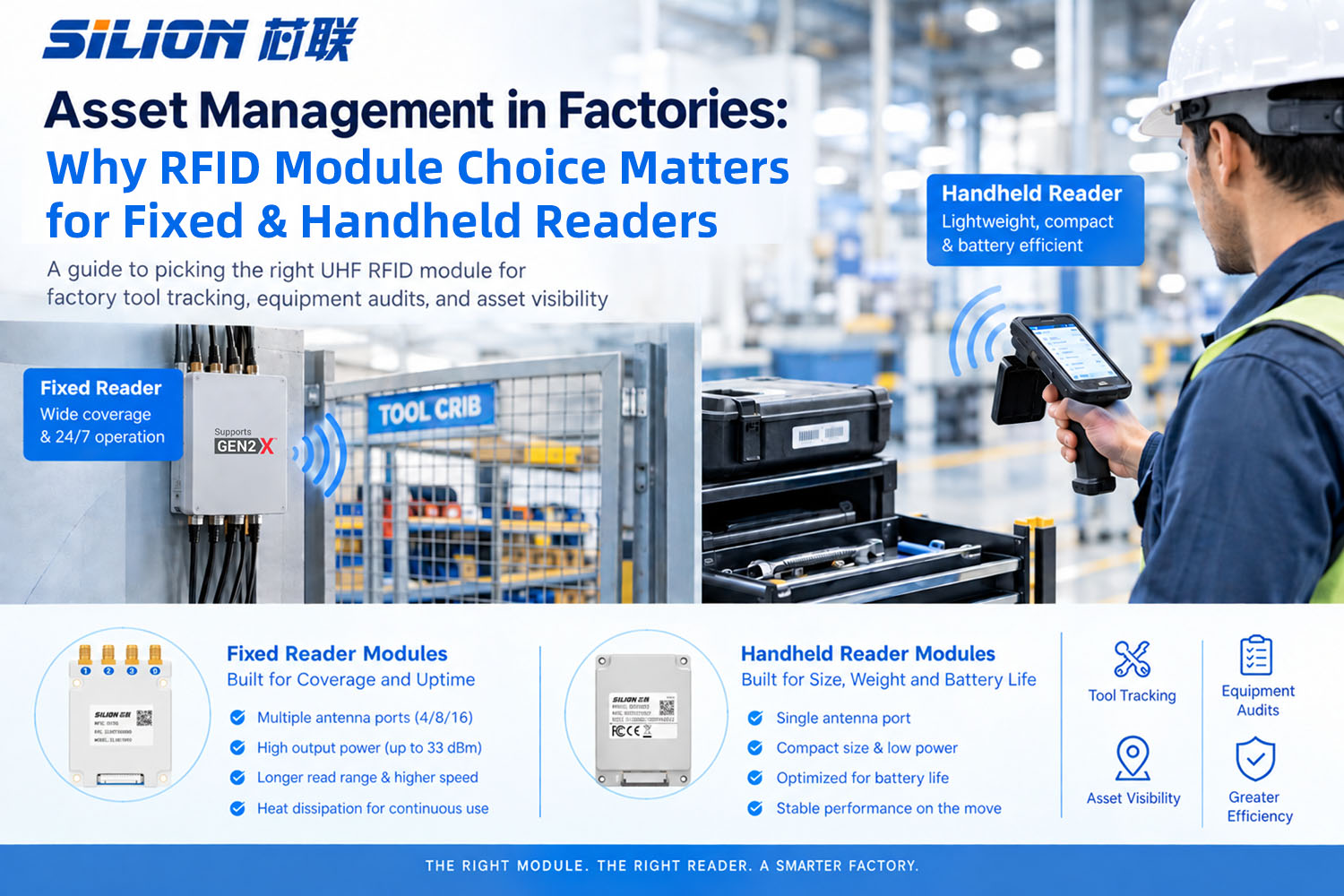
Why Factories Lose Track of Their Own Tools and Equipment
Walk into almost any factory and ask the maintenance team where every torque wrench, calibration gauge, or spare part is right now. Most of the time, nobody knows for sure. Tools get borrowed, moved between shifts, left on a different production line, or simply forgotten in a drawer. This is not a small problem. Missing tools cause delays, failed safety checks, and wasted money on buying replacements for equipment that was never actually lost, just misplaced.
This is exactly the kind of problem that RFID asset management was built to solve. Tag each tool once, and from then on, a reader can tell you where it is, when it moved, and who last checked it out, without anyone doing a manual count.
But here is the part that often gets missed: the reader you build is only as good as the module inside it. Two readers can look almost identical on the outside and still perform very differently, because one has a module built for the job and the other does not.
Fixed Readers and Handheld Readers Solve Different Problems
In a factory, you will usually end up using both types of readers, not just one.
Fixed readers sit in one place, like a gate at the tool crib door, a shelf in the calibration room, or a checkpoint on the production line. They read tags automatically, all day, with no one operating them.
Handheld readersgo wherever the technician goes. They are used for spot checks, audits, and finding a specific tool when someone needs it right now.
Because the two jobs are so different, the module inside each reader needs to be chosen differently too. Using the wrong module in the wrong reader is one of the most common mistakes we see when a factory builds its first RFID system.
What a UHF RFID Module Actually Does
A module is the small circuit board inside a reader that does the actual work of talking to the RFID tags. It sends out radio waves, listens for the tag's reply, and passes that information to the rest of the device. Everything else- the case, the screen, the antenna port cover- is built around this module.
This means the module decides things like:
• How far away a tag can be read from
• How many tags can be read at the same time
• How much power the reader uses
• How many antennas can be connected
• How well the reader handles interference from metal shelving or machinery
Fixed Reader Modules: Built for Coverage and Uptime
A fixed reader in a factory usually needs to watch a whole doorway, gate, or shelf, not just a single spot. For that, the module needs to support several antennas so the whole area is covered with no blind spots. A 4-port or 8-port module is common for a tool crib gate, while a busy warehouse-style checkpoint may use a 16-port module to cover a wider area with fewer readers overall.
Fixed readers also run non-stop, often 24 hours a day, plugged into mains power or Power over Ethernet. Since they are not limited by a battery, the module can push higher RF output power (commonly up to 33 dBm), which means a longer, more reliable read range even when tags are tucked inside metal toolboxes or stacked on a shelf.
Because these modules run all day, heat becomes a real concern. A good fixed-reader module is paired with proper heat dissipation, often through an aluminum housing, so performance does not drop after hours of continuous use.
Silion Tech's own product line reflects this. The SIM5200 module, built on the Impinj E510 chip, offers four SMA antenna ports and RF output up to 30 dBm, aimed squarely at fixed installations. For larger coverage needs, the 8-port SIM5300 and 16-port SIM5400, also on the E510 chip, support multiple antenna time-sharing, with read distances over 12 meters when paired with an 8dBi antenna, and an inventory speed above 600 tags per second thanks to their anti-collision algorithm and aluminum thermal panel.
Handheld Reader Modules: Built for Size, Weight, and Battery Life
A handheld reader lives in someone's hand or on their belt for a full shift. If the module inside is too large or draws too much power, the whole device becomes heavy, hot, and short on battery life, no matter how nice the case looks.
This is why handheld-focused modules are designed around a single antenna port (since the antenna is usually built into the device itself), a small footprint, and careful power management. Coin-sized modules exist specifically for this reason, so the RFID function fits into a phone-sized PDA or a wearable ring scanner without adding bulk.
Two Silion examples show this design approach clearly. The SIM7500, based on the Impinj E710 reader chip, measures just 28 mm by 28 mm and has one antenna port. While the hardware supports output up to 30 dBm, handheld battery powered designs typically operate around 23 dBm to conserve power. For teams that need more read range without giving up portability, the SIM9100, built on the high performance Impinj E910 chip, still keeps a single MMCX antenna interface but pushes output up to 33 dBm with high sensitivity, aimed at demanding handheld and mobile readers.
There is also a middle ground worth knowing about: modules such as SIM5100 (1-port) and SIM5200 (4-port), built for design flexibility. While they are primarily designed for fixed readers, they can technically be integrated into mobile reader designs for teams who want one module family across several device types. Note: its multi port hardware draws higher power; it is rarely implemented in battery powered handheld devices.
Fixed vs. Handheld Module: Side-by-Side
What You Need | Fixed Reader Module | Handheld Reader Module |
Antenna ports | Multiple (4, 8, even 16) to cover a wide area | Usually just 1, built into the device |
Size | Not critical, fits inside a housing on a wall or gate | Must be small and light, so the tool is easy to carry |
Power use | Runs on mains power or PoE, so battery life is not an issue | Must be power efficient, since it runs on a battery all day |
RF output power | Higher power (up to 33 dBm) for long-range, wide coverage | Moderate power (23 dBm and above), balanced for close-range work |
Heat handling | Needs good heat dissipation for 24/7 operation | Needs to stay cool without a heavy heat sink |
High power 33 dBm output must comply with regional FCC / ETSI radio regulatory limits; actual transmit power shall be tuned according to local radio rules.
A Simple Factory Example
Picture a mid-sized auto parts factory with one central tool crib and three production lines. A fixed reader module sits at the tool crib exit gate, watching every tool that leaves or returns, using a 4-port module so the whole doorway is covered. At the same time, a maintenance supervisor carries a handheld reader built around a small, single-port module, doing a five-minute walk-through of each line every morning to confirm nothing important has gone missing.
Neither reader alone gives the full picture. Together, using the right module for each job, they give the factory constant, low-effort visibility over its tools and equipment.
Common Mistakes When Choosing a Module
• Putting a high-power, multi-port module meant for fixed use into a handheld device, resulting in a heavy tool with poor battery life
• Using a small, single-port handheld module in a fixed gate reader, leaving gaps in coverage across a wide doorway
• Ignoring heat dissipation for a fixed reader that will run continuously, leading to performance drops over time
• Choosing a module based on price alone, without checking chip generation, antenna port count, or output power against the actual use case
Factory floors contain abundant metal machinery. Antenna layout and Gen2X anti-collision algorithms play critical roles alongside module selection.
Frequently Asked Questions
Do I need a different module for every reader in my factory?
Not necessarily. You need the right category of module for each job. Every fixed gate reader can use the same fixed-oriented module, and every handheld device can share a handheld-oriented module, as long as the coverage area and power needs are similar.
Can one module work for both fixed and handheld readers?
Some modules, like the SIM5100/SIM7100, are flexible enough for multiple form factor designs. While it is primarily designed for fixed readers, it can technically be integrated into mobile reader designs. Note: its multi port hardware draws higher power; it is rarely implemented in battery powered handheld devices. This can simplify sourcing, but it is still worth checking that the antenna ports and power output match what each specific reader needs to do.
Does a higher output power always mean a better module?
No. Higher power helps with range and reading through obstacles, but it also uses more energy and generates more heat. For a handheld device running on battery, a moderate, well-managed power level is usually a better fit than the highest number available.
What is the difference between an Impinj E510, E710, and E910 chip?
These are different generations of Impinj reader chips that Silion modules are built on. Compared with preceding generation chips such as the E510 and E710, the E910 delivers improved sensitivity and Gen2X enabled inventory performance within a compact footprint. It is widely used for both high end handheld readers and high performance fixed industrial readers.
Asset management in a factory is not just about slapping RFID tags on tools and hoping for the best. The reader hardware you choose, and specifically the module inside it, decides whether the system actually works well day to day. Fixed readers need modules built for wide coverage and non-stop operation. Handheld readers need modules built for size, comfort, and battery life. Getting this match right from the start saves both money and headaches down the line.
Silion Tech designs and manufactures UHF RFID modules for both fixed and handheld use, built on Impinj reader chips as an Impinj Gold Partner. If you are planning a factory asset management project and are not sure which module fits your reader design, our team can help you match the right module to the job.