Your location: Home Page > RFID Blog | SILION TECH > SIM3100 vs. SIM3110: Comparing Two Impinj E310-Based UHF RFID Modules
News and Information
SIM3100 vs. SIM3110: Comparing Two Impinj E310-Based UHF RFID Modules
Author:2026-09-29 16:00:00
The choice of a UHF RFID module depends on the requirements that are imposed on the RFID device, such as the type of antenna connection, RF power, connections, reading performance, power consumption, size, and others.
SILION TECH produces two UHF RFID modules based on the Impinj E310 reader chip: the SIM3100 and the SIM3110 RFID. Both modules support the EPC Class 1 Gen 2 (ISO 18000-6C). Nevertheless, there are essential differences between the modules in terms of antenna connection, RF output power, connectivity, performance, and application. This essay provides a comparison of the specifications and features of the SIM3100 and SIM3110 RFID modules based on the information provided on the manufacturer’s website.
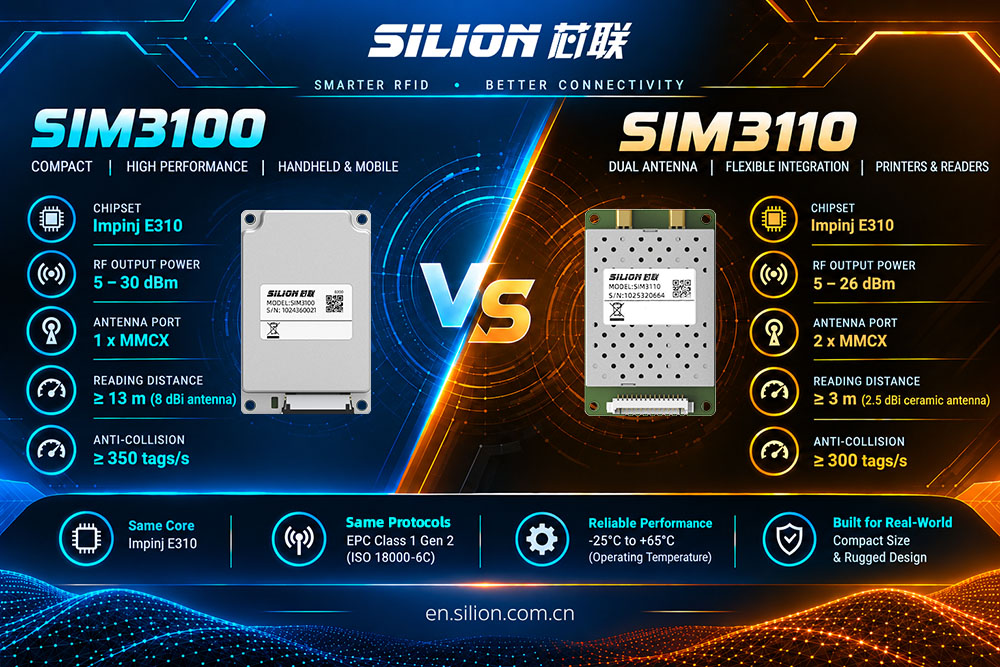
SIM3100: Designed for RFID Handheld Devices and Mobile Readers
The SIM3100 UHF RFID Module is a UHF RFID reader front-end module based on the Impinj E310 RAIN RFID reader chip. SILION TECH states that this product is designed for RFID handheld devices and mobile readers.
The module features one MMCX antenna interface and RF output up to 30 dBm. The product page promises exceptional miniaturization, RF performance, and anti-jamming design.
Moreover, SIM3100 offers such functions as RSSI detection, antenna connection-status detection, and operating-temperature detection. It is rated for operation at ambient temperatures of -25 degrees C to +65 degrees C and 5-95% relative humidity at +25C, non-condensing.
SIM3100 Key Specifications
• Chipset: Impinj E310
• Air protocol: EPC Class 1 Gen 2 (ISO 18000-6C)
• RF output power: 5–30 dBm, adjustable, ±1 dB
• Sensitivity: -73 dBm
• Antenna: One 50 Ω MMCX connector
• Reading distance: ≥13 m with 8 dBi antenna
• Anti-collision: ≥350 tags/s
• Dimensions: 55.9 × 35.6 × 6.5 mm
• Weight: 21 g
• Communication: 12-pin SFW12R-1STE1LF connector
• GPIO: 2 inputs and 2 outputs, DC 0–3.3 V
• Operating temperature: -25°C to +65°C
• Storage temperature: -40°C to +85°C
• Humidity: 5–95% non-condensing at +25°C
The page also states that the module can operate normally in 3.6 V low-voltage mode. Maximum power consumption in RF output mode is listed as 6.5 W, while standby power consumption is listed as 0.55 W and power-on consumption as 0.085 W.
SIM3110: A Two-Port UHF RFID Module
The SIM3110 is also based on the Impinj E310 reader chip, but it is designed as a 2-port UHF RFID module.
SILION TECH describes the SIM3110 as suitable for RFID printers or RFID readers. Its two MMCX antenna ports provide a key hardware difference from the single-port SIM3100.
The SIM3110 supports EPC Class 1 Gen 2 (ISO 18000-6C), tag RSSI acquisition, and adjustable RF power output from 5 to 26 dBm. The product page also lists API support for C, C#/.NET, and Java.
SIM3110 Key Specifications
• Chipset: Impinj E310
• Air protocol: EPC Class 1 Gen 2 (ISO 18000-6C)
• RF output power: 5–26 dBm, adjustable, ±1 dBm
• Sensitivity: -73 dBm
• Antenna: 2 × MMCX, 50 Ω
• Reading distance: ≥3 m with 2.5 dBi ceramic antenna
• Anti-collision: ≥300 tags/s
• Dimensions: 55.9 × 35.6 × 6 mm
• Weight: 20 g
• Communication: 15-pin connector, UART 3.3 V (TTL)
• GPIO: 2 inputs and 2 outputs, 3.3 V TTL
• Operating temperature: -25°C to +65°C
• Storage temperature: -40°C to +85°C
• Humidity: 5–95% non-condensing at +25°C
• API support: C, C#/.NET, Java
SIM3100 vs. SIM3110: Technical Comparison
Specification | SIM3100 | SIM3110 |
Reader Chip | Impinj E310 | Impinj E310 |
Air Protocol | EPC Class 1 Gen 2 (ISO 18000-6C) | EPC Class 1 Gen 2 (ISO 18000-6C) |
RF Output Power | 5–30 dBm | 5–26 dBm |
Sensitivity | -73 dBm | -73 dBm |
Antenna Ports | 1 × MMCX | 2 × MMCX |
Antenna Impedance | 50 Ω | 50 Ω |
Reading Distance | ≥13 m with 8 dBi antenna | ≥3 m with 2.5 dBi ceramic antenna |
Anti-Collision | ≥350 tags/s | ≥300 tags/s |
Dimensions | 55.9 × 35.6 × 6.5 mm | 55.9 × 35.6 × 6 mm |
Weight | 21 g | 20 g |
Communication | 12-pin SFW12R-1STE1LF | 15-pin UART 3.3 V (TTL) |
GPIO | 2 inputs + 2 outputs | 2 inputs + 2 outputs |
API Support | Not specified on page | C, C#/.NET, Java |
Operating Temperature | -25°C to +65°C | -25°C to +65°C |
Storage Temperature | -40°C to +85°C | -40°C to +85°C |
Humidity | 5–95% non-condensing | 5–95% non-condensing |
One Antenna Port vs. Two Antenna Ports
One of the clearest hardware differences between the two modules is their antenna configuration.
The SIM3100 has one 50 Ω MMCX antenna connector, while the SIM3110 has two 50 Ω MMCX antenna ports.
The SIM3100 page positions the module for RFID handheld devices and mobile readers, while the SIM3110 page specifically states that its two-port configuration is suitable for RFID printers or RFID readers.
RF Output Power
The modules also differ in their specified RF output ranges.
The SIM3100 supports adjustable RF output from 5 dBm to 30 dBm, while the SIM3110 supports adjustable RF output from 5 dBm to 26 dBm.
The SIM3100 page notes that +30 dBm is the absolute maximum and that maximum power may need to be reduced to comply with regulatory limits, taking into account the combined effect of the module, antenna, cable, and enclosure shielding of the integrated product.
Reading Performance
The two product pages provide different reading-performance specifications.
For the SIM3100, the technical specification lists a reading distance of ≥13 m with an 8 dBi antenna and anti-collision performance of ≥350 tags/s.
For the SIM3110, the technical specification lists a reading distance of ≥3 m with a 2.5 dBi ceramic antenna and anti-collision performance of ≥300 tags/s.
These figures are specified under different antenna conditions, so they should not be treated as a direct antenna-for-antenna performance comparison.
Connectivity and Software Support
The modules use different communication interfaces.
The SIM3100 uses a 12-pin SFW12R-1STE1LF connector for power supply, communication, and GPIO. It provides two inputs and two outputs with a DC range of 0–3.3 V.
The SIM3110 uses a 15-pin connector with UART 3.3 V (TTL) and provides two 3.3 V TTL inputs and two 3.3 V TTL outputs.
The SIM3110 product page additionally specifies API support for C, C#/.NET, and Java.
Size and Power
Both modules have a compact form factor.
The SIM3100 measures 55.9 × 35.6 × 6.5 mm and weighs 21 g.
The SIM3110 measures 55.9 × 35.6 × 6 mm and weighs 20 g.
For the SIM3100, the page specifies 6.5 W maximum consumption in RF output mode, 0.55 W in standby, and 0.085 W during power-on.
For the SIM3110, the page specifies an input voltage of 3.6–5.25 V ±5% and power consumption of 3 W in RF output mode.
Which Module Fits Your Device Requirements?
The two product pages highlight the differences between the modules:
The SIM3100 is described for RFID handheld devices and mobile readers; there is 1 antenna port, the RF output is adjustable up to 30 dBm, and the technical specification lists ≥13 m reading distance with an 8 dBi antenna;
The SIM3110 is described for RFID printers or RFID readers; there are 2 antenna ports, the RF output is adjustable up to 26 dBm, and the API supports C, C#/.NET, and Java.
Therefore, the choice between the two comes down to the hardware configuration and requirements of the RFID device being developed.
The SIM3100 and SIM3110 are both UHF RFID modules that make use of the Impinj E310 reader chip, and both support EPC Class 1 Gen 2 (ISO 18000-6C).
In short: choose the SIM3100 for single-port handheld and mobile readers with up to 30 dBm output; choose the SIM3110 for two-port RFID printers and fixed readers with API support for C, C#/.NET, and Java.
They both offer a compact embedded platform, and their respective specifications allow developers to choose the right module for the requirements of their RFID device.