Your location: Home Page > RFID Blog | SILION TECH > SIM7200 vs. SIM7300: What Is the Difference Between 4-Port and 8-Port UHF RFID Modules?
News and Information
SIM7200 vs. SIM7300: What Is the Difference Between 4-Port and 8-Port UHF RFID Modules?
Author:2026-10-09 17:00:00
When designing an RFID system, one key decision is choosing the right number of antenna ports. SILION TECH offers UHF RFID modules based on the latest Impinj E710 RAIN RFID reader chip, such as the SIM7200 4-port module and the SIM7300 8-port module. These modules both offer high reading performance, good anti-collision ability, and support for Impinj Gen2X technology, although they are intended for different application needs.
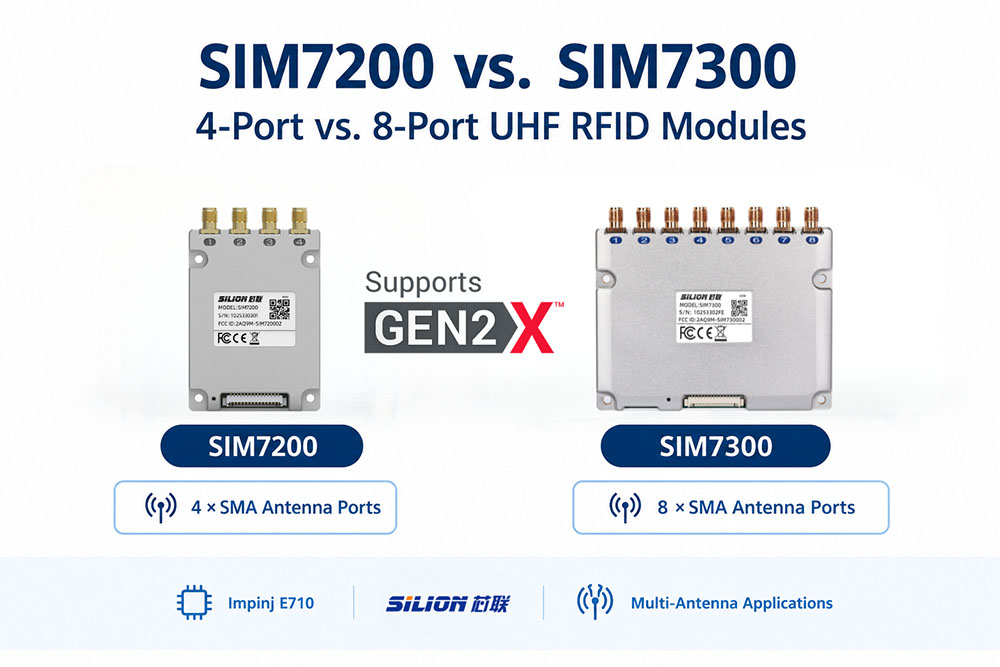
What Is the Main Difference Between SIM7200 and SIM7300?
The biggest difference is the number of antenna ports.
• SIM7200: 4 × 50Ω SMA antenna connectors
• SIM7300: 8 × 50Ω SMA antenna connectors
More antenna ports allow an RFID system to cover a larger reading area without adding additional reader devices. The SIM7300 supports more antennas than the SIM7200, making it suitable for applications requiring wider coverage or multiple reading zones.
Similarities Between SIM7200 and SIM7300
Both modules are built on the Impinj E710 reader chip and support EPC Class 1 Gen 2 (ISO 18000-6C) air protocols. They also provide:
• Adjustable RF output power from 5 dBm to 30/33 dBm
• Tag RSSI support
• Antenna detection
• Temperature detection
• Fixed or frequency-hopping working modes
• UART communication
• API support for C, C#/.NET, and Java
• Support for Impinj Gen2X technology
These shared features provide high RFID performance and flexible integration into various RFID devices.
Performance Comparison
Both modules offer excellent reading capability.
Feature | SIM7200 | SIM7300 |
Chipset | Impinj E710 | Impinj E710 |
Antenna Ports | 4 SMA | 8 SMA |
RF Output | 5–30/33 dBm | 5–30/33 dBm |
Sensitivity | -86 dBm | -86 dBm |
Reading Distance | ≥22 m with 8 dBi antenna | ≥22 m with 8 dBi antenna |
Anti-collision | ≥1000 tags/s | ≥1000 tags/s |
Both modules provide high-speed multi-tag reading and long reading distances when used with an 8 dBi antenna.
Note:
≥22 m is lab measured maximum performance using 8 dBi antenna under ideal open air conditions. Real world range will be reduced by cable loss, metal/liquid interference, and regional RF regulatory power limits.
Maximum 33 dBm hardware output must be adjusted to comply with local FCC / ETSI radio regulatory requirements for end device deployment.
Which Module Should You Choose?
The SIM7200 can be used with RFID devices that need four antenna connections, for example those that are fixed RFID readers or high-performance RFID equipment.
The SIM7300 is intended for use in applications which require greater antenna coverage via eight antenna ports and by means of multiple antenna time-sharing functions; its bigger size and the greater number of antenna interfaces offer more flexibility for complex RFID systems.
Whether to choose a 4-port or an 8-port RFID module mainly comes down to the antenna requirements and the desired system coverage. The SIM7200 features four antenna interfaces in a compact design, whereas the SIM7300 increases this to eight antennas for use in larger RFID applications.
Note: The 8 port module uses antenna time division multiplexing; only one antenna is active at any given time. More antennas will extend total inventory cycle time for full zone scanning.
As both modules make use of the advanced Impinj E710 reader chip, users are able to achieve high sensitivity, outstanding anti-collision performance, and reliable RFID reading capability.
How many antennas does your RFID system need?
For more information about SILION TECH RFID modules, visit SILION TECH RFID Modules.